How Do I Get Rid of Pest in Dubai?

The Arabian Sand Boa is a small, secretive, non-venomous snake superbly adapted to life beneath the desert sand. With upward-facing eyes and a blunt tail, it spends almost all its time burrowed under the surface, ambushing small prey from below, and is rarely seen above ground. It poses no venom threat to people — it's harmless and not aggressive — so its discovery in a desert-edge garden or, occasionally, indoors is far less alarming than a viper or cobra. That said, correct identification matters: people often panic at any snake, and a professional can confirm the species, remove it safely, and reassure occupants. Killing harmless native snakes is both unnecessary and ecologically counterproductive, as they help control rodents.

Santera's Dubai Municipality-certified technicians identify and safely relocate Sand Boas, confirming the species and advising on simple measures to keep snakes out, in line with Dubai Municipality and wildlife-handling standards. For villas and compounds near the desert, we provide calm, expert response and humane removal.

Book Your Free Inspection

Species Insights & Biology

Get to know the physical signs and behavioral patterns associated with this species. Knowledge of these specific traits helps in maintaining a secure and pest-free environment.

Appearance

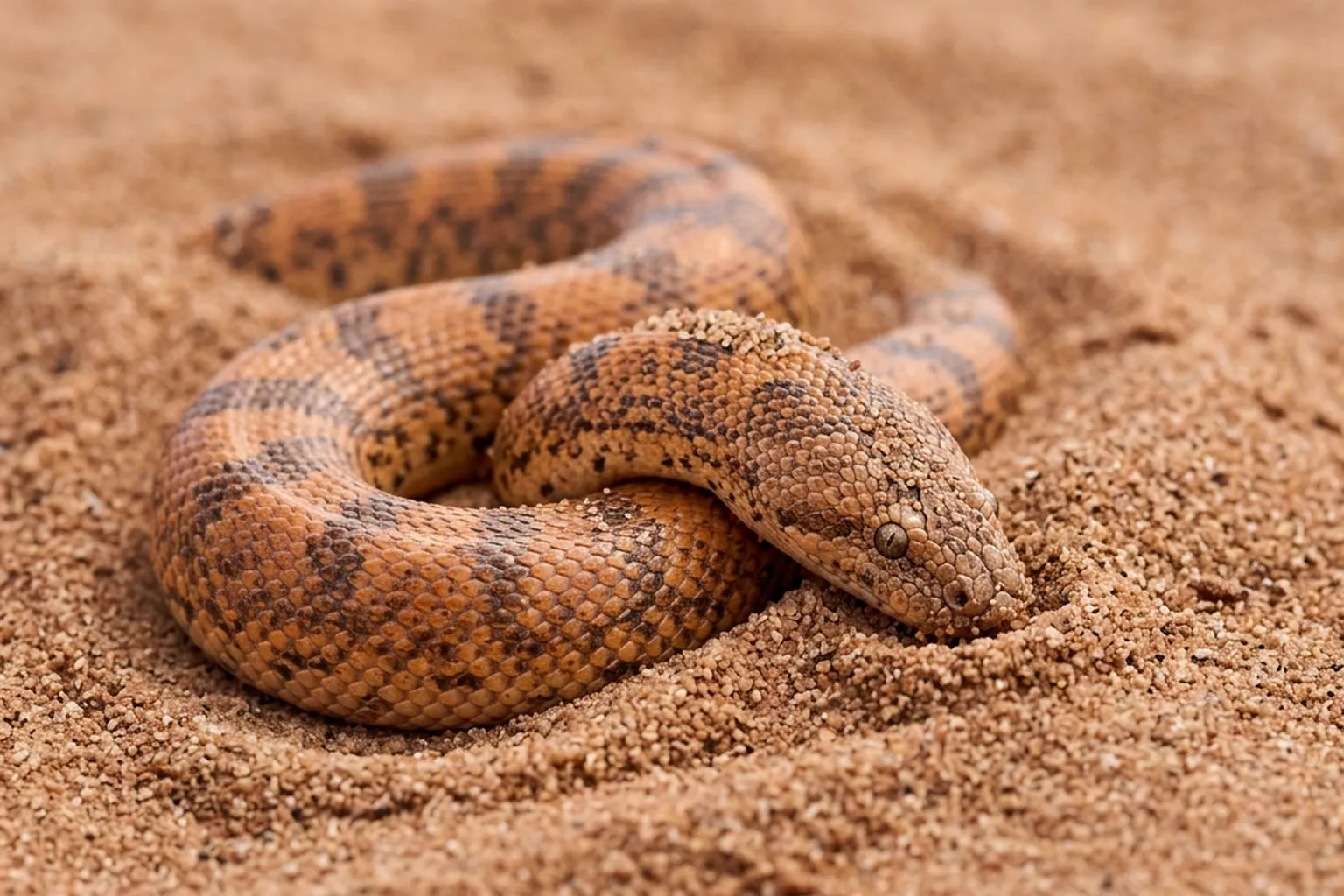
The Arabian Sand Boa is small, usually 30–40cm, with a stout cylindrical body, a short blunt tail, and a wedge-shaped head barely distinct from the neck. Its eyes are small and positioned high on the head — an adaptation for burrowing — and it is pale sandy-yellow to orange with darker blotches, blending perfectly with desert sand. It is non-venomous with smooth scales.

Diet

The Arabian Sand Boa preys on small desert animals — lizards, small rodents, and other small prey — which it ambushes from beneath the sand, constricting them. In Dubai, gardens and areas with small lizards and rodents can occasionally attract it, and as a predator of small pests it is ecologically beneficial.

Behavior

The Sand Boa is nocturnal and fossorial, spending almost all its time buried in loose sand with only its eyes sometimes exposed. It ambushes prey from below and rarely moves in the open. It is shy and non-aggressive toward people, and encounters are uncommon and harmless, usually occurring when the snake is unearthed during gardening or surfaces at night.

Reproduction

The Arabian Sand Boa is notable for laying eggs (unusual among sand boas, many of which bear live young), with females producing a small clutch. As a harmless, beneficial native species, its presence is not a danger, though removal and relocation may still be desired for peace of mind.

Prevention Tips

As a harmless species, no urgent action is needed, but to reduce snake presence generally, keep sandy areas tidy, control rodents and lizards, and seal gaps under gates and doors. If a Sand Boa is found indoors or causes concern, avoid harming it — it's non-venomous and beneficial. Call Santera for safe identification and humane relocation, and reassurance about the species.

Where We Treat Pest in Dubai

Santera provides Pest control and prevention across Dubai, with primary service coverage in:

place
Dubai Creek Harbour
place
City Walk
place
Bluewaters
place
Palm Jumeirah
place
Dubai Festival City
place
Jumeirah Islands
place
Jumeirah Park
place
Meydan
place
The Valley
place
DAMAC Lagoons
place
DAMAC Hills 2
place
Sobha Hartland
place
Sustainable City
place
International City
place
Dubai Sports City
place
Dubai Silicon Oasis
place
The Greens
place
Discovery Gardens
place
Al Furjan
place
Barsha Heights
place
Al Barsha
place
JLT
place
Dubai Marina
place
Business Bay
place
Deira
place
Ras Al Khor
place
Al Jaddaf
place
Mina Rashid
place
Dubai Festival City
place
Dubai World Trade Centre
place
Dubai Harbour
place
Dubai Studio City
place
Dubai Knowledge Park
place
Dubai Design District (d3)
place
Barsha Heights
place
Dubai Creek Harbour
place
Dubai Hills
place
MBR City
place
Dubai South
place
Expo City
Sand Boa

Common Questions & Expert Answers

Book Your Free Inspection
How does Santera get rid of Sand Boas in Dubai?

Santera handles Sand Boas in Dubai with a Dubai Municipality-certified, safety-first process: trained technicians locate and deal with the snake itself, safely using proper equipment, then advise on prevention so the risk doesn't return. Given the danger, this should never be attempted yourself.

Can I get rid of Sand Boas myself, or do I need professional pest control?

It isn't safe to deal with Sand Boas yourself. Attempting to handle or remove them risks the risk of handling a snake yourself, and DIY methods rarely resolve the underlying problem. The safe, effective route is trained professional response.

Why do Sand Boas keep coming back after I treat them?

Because the source survives. The Arabian Sand Boa is notable for laying eggs (unusual among sand boas, many of which bear live young), with females producing a small clutch. As a harmless, beneficial native species, its presence is not a danger, though removal and relocation may still be desired for peace of mind. That's exactly why surface sprays and one-off DIY fail — they hit what's visible while the source keeps producing more, so lasting control has to target the source, not just the symptoms.

How do I know if I have a Sand Boa problem in Dubai?

Watch for Sand Boas themselves and the signs they leave. The Arabian Sand Boa is small, usually 30–40cm, with a stout cylindrical body, a short blunt tail, and a wedge-shaped head barely distinct from the neck. The Sand Boa is nocturnal and fossorial, spending almost all its time buried in loose sand with only its eyes sometimes exposed. It ambushes prey from below and rarely moves in the open. Catching it early, before numbers build, makes treatment far easier.

Are Sand Boas dangerous?

No — the Arabian Sand Boa is non-venomous and harmless to people. It's a beneficial rodent predator, though you may still want it safely relocated for peace of mind.

What attracts Sand Boas to homes and businesses in Dubai?

The Arabian Sand Boa preys on small desert animals — lizards, small rodents, and other small prey — which it ambushes from beneath the sand, constricting them. In Dubai, gardens and areas with small lizards and rodents can occasionally attract it, and as a predator of small pests it is ecologically beneficial. Cut off these food, water, and shelter sources and you remove what draws them in — but an established population still needs targeted treatment to clear fully.


Experience Guaranteed Results and Satisfied Pest Treatment Services

20+

Years Experience

All

Across UAE

10k+

Treatments

Select a Service

What pest problem can we help you with?

Property Details

Tell us about your property

Choose Date & Time

When would you like us to visit?

Contact Information

How can we reach you?

Expert Help is on the Way!

We’ve received your request. Santera is ready to protect your home/business—talk to you soon!
Oops! Something went wrong while submitting the form.