Termites
Termites in Dubai Villas: The Complete 2025 Guide to Signs, Treatment & Prevention
Muhammad Saif Ullah
September 13, 2026


Most homeowners assume termites are a tropical problem. In Dubai, they’re a desert problem.
The Coptotermes species dominant here — particularly Coptotermes gestroi and Coptotermes heimi — are subterranean termites. They live in the soil beneath and around your villa’s foundations. Dubai’s sandy, loamy soils are easy to tunnel through. The underground irrigation systems that keep villa gardens green also keep that soil moist — exactly what subterranean termites need to thrive.
Add to this the timber-frame construction common across Arabian Ranches, The Springs, Meadows, and The Villa, and you have near-perfect conditions for a colony to establish, grow, and feed undetected for 12 to 18 months before any external sign appears.
The Dubai-specific conditions that accelerate termite risk:
Catching termites early is the difference between a treatment programme and a structural repair. These are the signs that matter — in order of how commonly they appear.
This is the most reliable early indicator. Subterranean termites cannot survive exposure to Dubai’s dry air. They build sealed mud tubes — roughly the width of a pencil — to travel from the soil up through walls, foundations, and any point where structure meets ground.
A mud tube you break open will still contain live termites if the colony is active. If dry and empty, the colony may have moved.
Tap door frames, skirting boards, and timber furniture legs with your knuckle. Solid, untouched wood gives a dense thud. Termite-damaged wood gives a hollow, papery sound — the termites have eaten the interior and left only the surface skin intact.
Drywood termites push their droppings out of the wood as tiny, hard pellets — like fine sawdust or coffee grounds. If you find frass, you have an active infestation. The colony is nearby.
In the weeks following Dubai’s winter rains (January to March), termite reproductives swarm. After landing, they shed their wings. Piles of small translucent wings near windowsills signal a colony has recently swarmed nearby.
Termite activity produces moisture as the colony feeds. This moisture warps timber. A door frame that begins to stick for no apparent reason — especially ground floor — deserves an inspection, not a dismissal as humidity.
By the time you see bubbling paint or visible grooves in timber, the infestation is advanced. The timber underneath will be heavily compromised. This is a structural conversation, not just pest control.
Most homeowners picture termites tunnelling up from beneath a villa. That’s accurate — but there are entry routes that are far less obvious.
AC drainage lines are a major one. Condensate drain lines running from AC units through walls to external drain points can, over time, create a persistent damp zone inside the wall cavity — ideal termite habitat, invisible until opened.
Paving and landscaping raised against the wall can bridge the DPC (damp proof course). When garden renovations raise soil or paving levels against the villa wall, this termite barrier is bypassed.
Expansion joints — filled with flexible sealant that ages and cracks — become a direct entry channel from soil to wall cavity.
Timber deliveries and second-hand furniture can introduce drywood termites directly into your home.
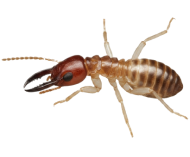
By far the most common and destructive in Dubai. The colony can number in the millions. Workers travel up through mud tubes to feed on timber in the structure. The queen is never in the building — she’s deep in the soil. Spraying the timber does nothing. Effective treatment reaches the soil and the queen.
Less common but increasingly present in Dubai, particularly in villas with imported furniture or timber. These termites live entirely within the wood they infest — no soil contact needed. Soil barriers are irrelevant for drywood species.
A liquid termiticide is injected into the soil around and beneath the villa’s foundations in a continuous barrier. The chemical spreads through the colony via contact transfer — a worker moving through treated soil carries the toxicant back to the nest. Applied correctly, a quality barrier provides 8–10 years of protection.
Bait stations placed in the soil around the villa perimeter attract worker termites, who carry the bait back to the colony — including to the queen. The colony collapses over 8–16 weeks. This is the method of choice when drilling is not feasible.
For drywood infestations, a residual termiticide applied directly to the wood kills termites on contact and provides surface-level residual protection.
After treatment, in-ground monitoring stations around the perimeter are checked every 1–3 months. Any new activity triggers immediate targeted treatment — the professional standard for high-risk villa communities.
Pre-construction soil treatment is the most cost-effective moment to act. Before a slab is poured, the entire footprint can be treated continuously. If you are building or renovating a villa in Dubai, insist on pre-construction treatment by a Dubai Municipality-licensed operator.
No. DIY products don’t reach the colony in the soil. The queen continues reproducing. Only a Dubai Municipality-licensed operator can apply the soil-barrier or baiting treatment that reaches the colony.
A soil barrier for a standard 3–4 bedroom villa takes 4–6 hours. Any operator claiming under 2 hours hasn’t done the full perimeter properly.
No for soil barrier treatments. Yes for fumigation (drywood, severe cases) — 24–72 hours. Always communicated clearly in advance.
Check handover documents or contact the developer. Pre-construction treatment expires after 5–8 years. If your villa is 8–12 years old, it may have lapsed.
Santera’s Dubai Municipality-certified specialists inspect your villa, document every finding, and give you a clear treatment recommendation with no obligation.
WhatsApp or call: +971 4 332 2623
Email: info@santera.ae
Book online: santera.ae
We cover all Dubai villa communities — Arabian Ranches, The Springs, Meadows, Emirates Hills, Jumeirah Golf Estates, Al Barsha, Mirdif, and beyond.
A 45-minute inspection today is considerably less painful than a structural repair bill next year.