Termites
Termite Protection for Dubai Hotels: Safeguarding Guest Rooms, Woodwork and Reputation
Muhammad Saif Ullah
September 19, 2026


A termite colony does not check a hotel's star rating before it moves in. Landscaped grounds, irrigation lines, and timber joinery in guest rooms and lobbies give termites exactly the moisture and cellulose they need, and a Dubai hospitality property runs all three at scale. For a hotel, the risk is not just structural. A guest who spots mud tubes along a skirting board or finds a hollow, crumbling headboard does not file a maintenance ticket quietly, they leave a public review. Termite prevention on a hospitality property has to protect the building and the brand at the same time.
Hotel grounds are built for guest experience first, and that works in a termite's favour. Mature landscaping with regular irrigation sits close to the building envelope, ornamental timber features appear in lobbies and gardens, and back-of-house areas often hold stored timber, pallets, or joinery offcuts that never make it into a pest inspection checklist. Add Dubai's warm, humid climate, which keeps termite activity high year round rather than seasonal, and a property with dozens of independent guest rooms and a large footprint of landscaped grounds has considerably more exposure points than a typical villa.
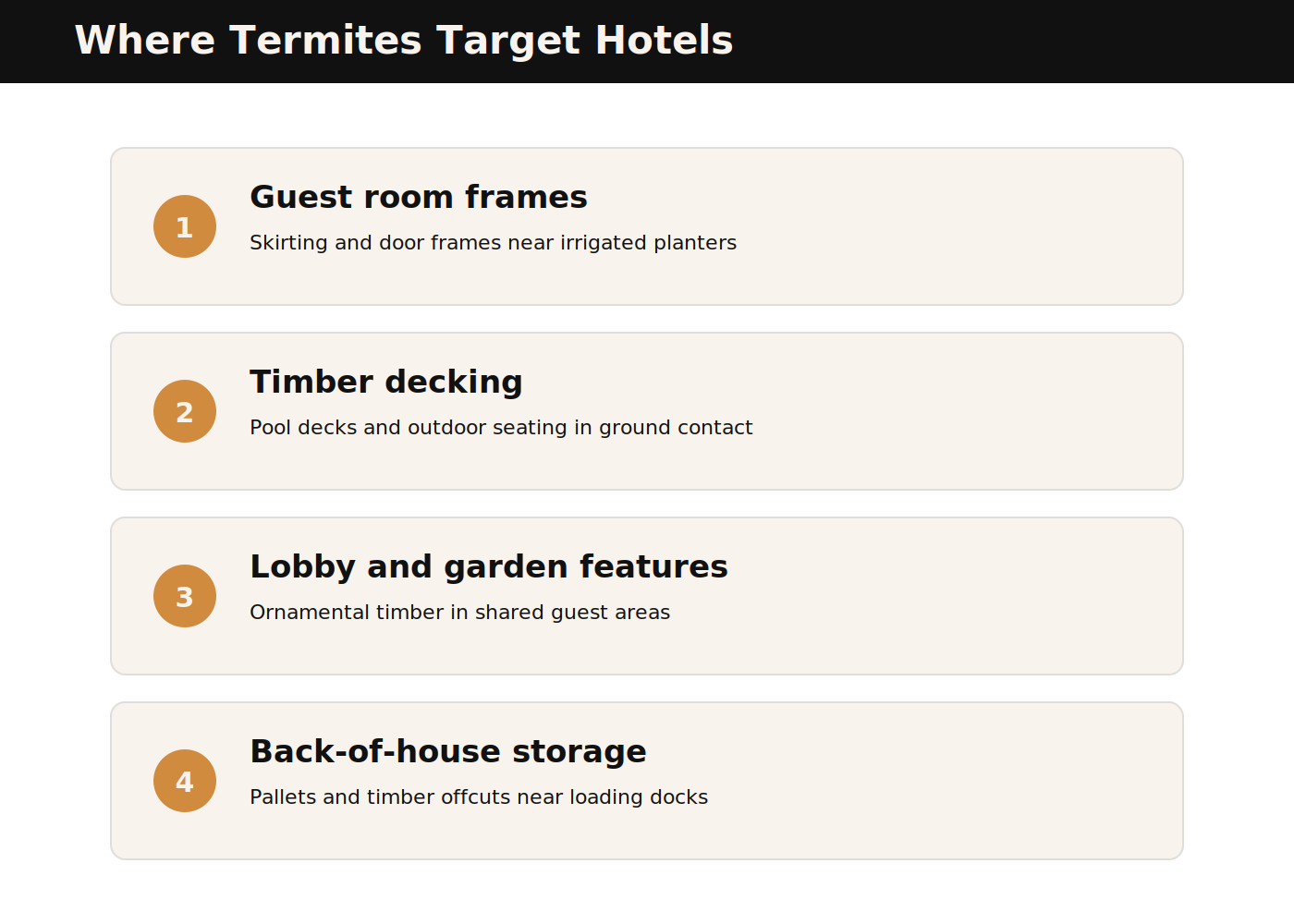
Termites concentrate wherever timber, moisture, and undisturbed access overlap. On a hotel property, that typically means guest room skirting boards and door frames near irrigated planters, timber decking around pools and outdoor seating areas, ornamental features in lobbies and gardens, and back-of-house timber storage or pallet stacks near loading docks. Expansion joints and plumbing risers running between floors can also give a colony a hidden route between levels. Housekeeping and engineering teams that only check visible, guest-facing areas often miss these secondary zones, which is exactly why professional inspection covers grounds and back-of-house spaces as thoroughly as guest rooms.
Termite damage is a slow-moving problem until it suddenly is not. A guest room headboard or door frame that looks fine on a routine walk-through can be structurally compromised underneath, and the first visible sign is often a guest complaint rather than a maintenance discovery. For a hotel, that complaint rarely stays private. Online reviews, group booking decisions, and repeat guest loyalty all depend on a property being maintained to a standard guests do not have to think about. A documented termite prevention programme lets a hospitality operator stay ahead of that risk instead of reacting to it room by room.
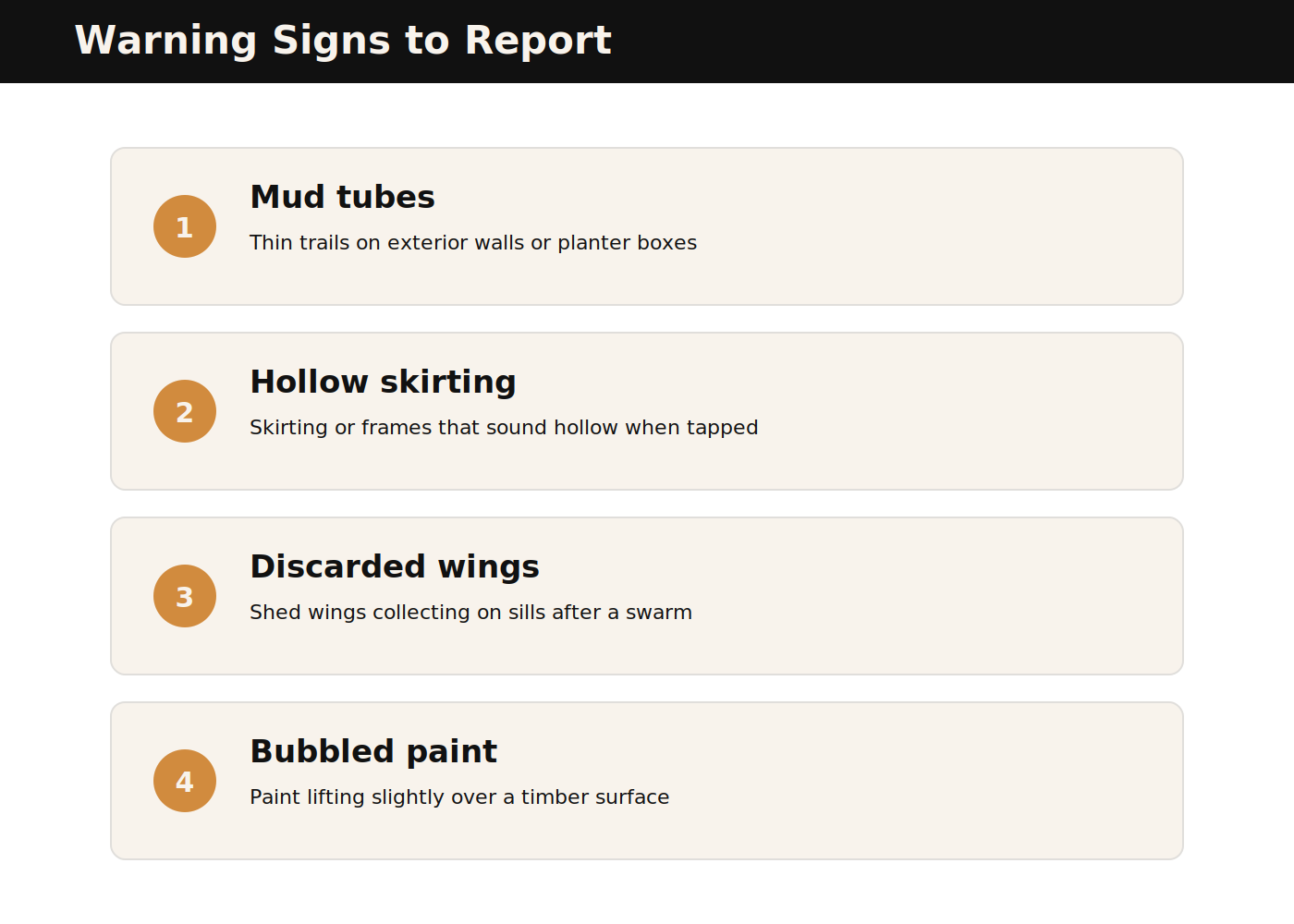
Termite activity rarely announces itself in a guest-facing area with an obvious sighting. Early indicators are subtle: thin mud tubes running up an exterior wall or planter box, skirting boards or door frames that sound hollow when tapped, discarded wings collecting on a windowsill after a swarm, or paint that looks slightly bubbled over a timber surface. Housekeeping staff are often the first to notice something in a guest room, and engineering teams doing routine grounds checks are best placed to catch early activity outdoors, but only if there is a clear process for escalating what they see. Any of these signs should trigger a professional inspection rather than a spot repair, since patching over active termite damage only hides the problem temporarily.
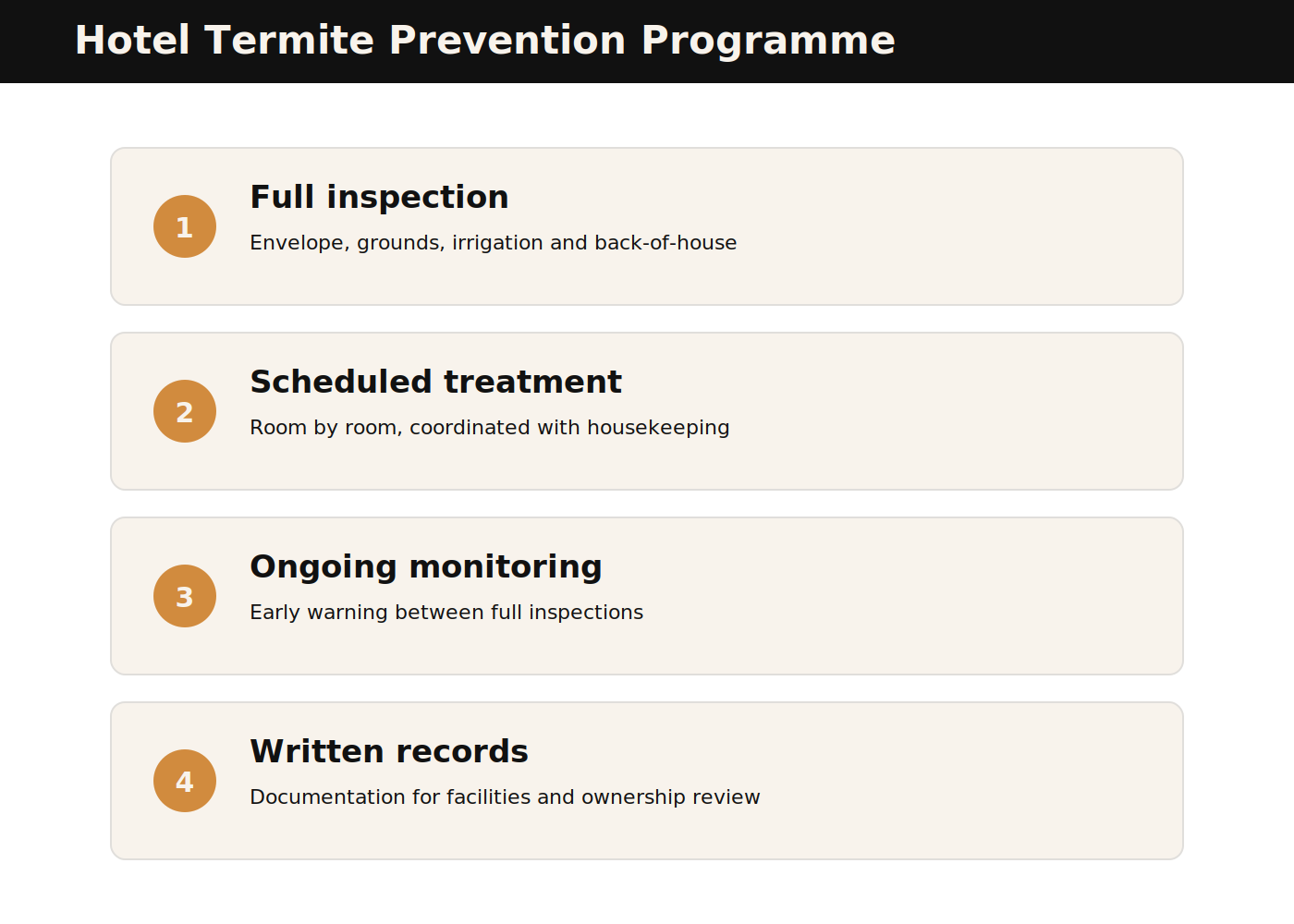
A termite programme built for a hospitality property has to work around occupancy, not against it. That means inspection and treatment scheduled room by room or block by block, coordinated with housekeeping and front office so guest rooms stay bookable. A full programme covers the building envelope, landscaped grounds and irrigation lines, back-of-house timber storage, and common guest areas such as lobbies and outdoor seating, not just a single reported room. Ongoing monitoring between full inspections gives facilities teams early warning, and a written service record supports both internal maintenance planning and any insurance or ownership review of the property.
When selecting a termite control provider for a Dubai hotel, facilities managers should confirm the company is Dubai Municipality certified and ask specifically how they schedule treatment around occupancy, coordinate with engineering and housekeeping, and document findings for ownership or insurance purposes. A provider experienced with hospitality properties should be able to explain how they handle guest room access without disrupting front office operations. Santera is Dubai Municipality certified, with 25+ years of team experience across commercial and hospitality properties in Dubai, and structures every hotel visit around minimal disruption to guests and staff.
Read more in our Pest Library guide to termites.
Yes. Treatment is typically scheduled room by room around occupancy, or during planned refurbishment blocks, so guest rooms stay bookable throughout. Our technicians coordinate timing directly with your engineering or housekeeping team.
Newer properties are not automatically protected. Landscaping maturing around the building, timber formwork left in the ground during construction, and joinery installed after the original soil treatment can all create fresh entry points regardless of the building's age.
Most Dubai hospitality properties benefit from a recurring inspection schedule rather than a one-time check, since landscaping, plumbing risers, and back-of-house timber stores are in constant use. Your facilities team can agree a frequency that matches the property's size and grounds.
Note the room number and the exact location of any mud tubes, hollow-sounding skirting, or damaged joinery, avoid disturbing the area, and hold the room from sale until a professional inspection confirms the extent of activity. Early reporting keeps treatment contained and guest-facing disruption minimal.
Termite activity on a hospitality property moves quickly from a maintenance note to a guest experience and reputation issue if it is left unaddressed. Santera is Dubai Municipality certified and works with hotels and hospitality operators across Dubai to build inspection and treatment programmes around occupancy, not against it. Book a complimentary inspection via WhatsApp to review your property's risk areas.