Stored Product Pests
Stored Product Pest Control for Dubai Warehouses and Distribution Centers: Protecting Bulk Inventory
Muhammad Saif Ullah
September 15, 2026


{"@context":"https://schema.org","@graph":[{"@type":"LocalBusiness","name":"Santera Pro for Public Health Pests Control Services L.L.C.","telephone":"+971 4 332 2623","email":"info@santera.ae","address":{"@type":"PostalAddress","streetAddress":"Store 104, Al Quoz 3","addressLocality":"Dubai","addressCountry":"AE"},"areaServed":"Dubai","priceRange":"AED"},{"@type":"Article","headline":"Stored Product Pest Control for Dubai Warehouses and Distribution Centers: Protecting Bulk Inventory","author":{"@type":"Person","name":"Muhammad Saif Ullah"},"publisher":{"@type":"Organization","name":"Santera Pro for Public Health Pests Control Services L.L.C."},"mainEntityOfPage":{"@type":"WebPage","@id":"https://www.santera.ae/blog/stored-product-pest-control-dubai-warehouse"}},{"@type":"FAQPage","mainEntity":[{"@type":"Question","name":"How quickly can stored product pests spread through a warehouse?","acceptedAnswer":{"@type":"Answer","text":"Once weevils, beetles, or moths establish themselves in a single pallet, they can spread to adjacent stock within weeks, especially in Dubai's warm ambient temperatures, which accelerate breeding cycles. Bulk storage means one infested consignment can put an entire zone of a warehouse at risk before staff notice any visible sign."}},{"@type":"Question","name":"Can warehouse staff treat an infested pallet themselves before it ships out?","acceptedAnswer":{"@type":"Answer","text":"Spot treatment by untrained staff rarely reaches larvae hidden inside packaging, pallet timber, or product itself, and it does not address the source of entry. For 3PL and distribution operators, an undocumented in-house response can also break the chain of custody a client or food safety auditor expects to see."}},{"@type":"Question","name":"How often should a Dubai distribution center be inspected for stored product pests?","acceptedAnswer":{"@type":"Answer","text":"Facilities handling bulk food, grain, or dry goods generally benefit from scheduled monitoring rather than a one-off visit, since new pallets and shared loading docks introduce fresh risk continuously. A recurring inspection and trap-monitoring schedule catches activity while it is still confined to a small area."}},{"@type":"Question","name":"What happens if a client audit finds evidence of stored product pests in our facility?","acceptedAnswer":{"@type":"Answer","text":"A failed audit can mean rejected shipments, contract penalties, or loss of a retail or food-service client relationship. Having a documented, Dubai Municipality-certified pest control program in place gives 3PL operators evidence of due diligence and a faster path back to compliance."}}]}]}
For a warehouse or distribution center in Dubai, stored product pests are not a minor nuisance confined to one shelf or one bag of flour. Weevils, beetles, and moths that infest bulk food, grain, or dry-goods inventory can put an entire pallet, or an entire shipment, at risk of rejection. In a logistics operation built around throughput and client contracts, that risk carries a commercial weight that a single-item infestation in a small retail store never does.
Dubai's position as a regional trade and logistics hub means bulk food and dry-goods stock moves through warehouses and distribution centers constantly, often arriving from multiple origin countries before being broken down and redistributed to retail and food-service clients across the city. That volume and turnover, combined with Dubai's warm climate, creates ideal breeding conditions for stored product pests once they gain a foothold in palletized stock. Unlike a supermarket shelf, a warehouse holds inventory in bulk and often in the dark, in stacked pallets and shrink-wrapped cartons, where an early infestation can go unnoticed for weeks before it surfaces during picking or a client inspection.
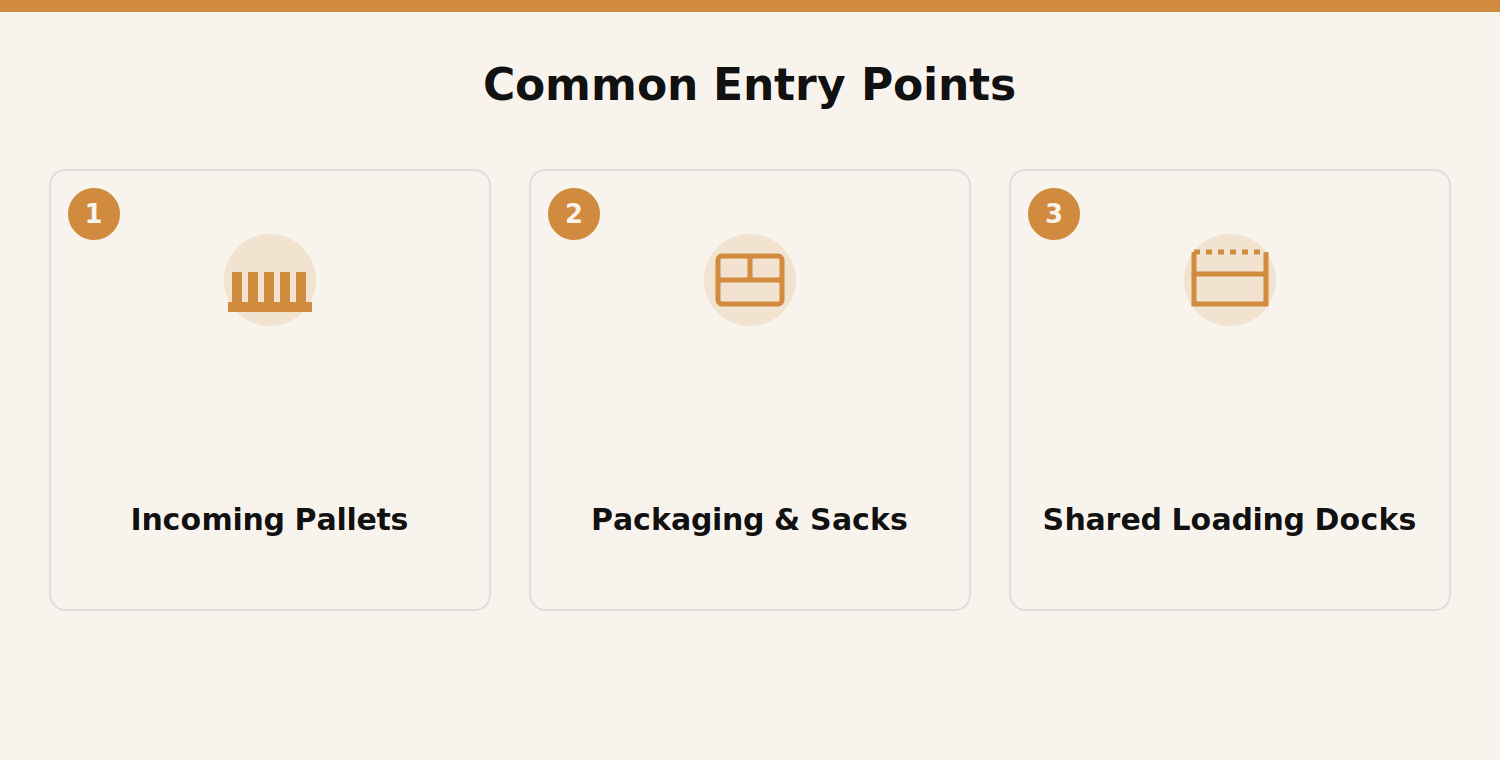
In most Dubai facilities, stored product pests do not originate inside the building. They arrive with the goods, inside incoming pallets, cardboard packaging, and sacks, or they move in through shared loading docks used by multiple carriers and tenants. Gaps around dock levelers, poorly sealed roller doors, and shared receiving bays give adult moths and beetles a direct route from an infested delivery into clean storage areas. Once inside, they spread from the point of entry to neighboring pallets, particularly where stock is stored close together to maximize warehouse space.
The commercial consequence of stored product pests in a warehouse setting is different in scale from a retail environment. A distribution center handling bulk grain, flour, rice, or packaged dry goods for multiple clients risks contamination spreading across an entire pallet or storage bay rather than a single packet. For 3PL operators, that can mean an entire consignment rejected by a retail or food-service client, a breach of a food safety chain-of-custody requirement, or a contract dispute over responsibility for spoiled stock. Reputational damage compounds the direct loss, since clients who discover contaminated shipments are unlikely to renew a storage or distribution contract.
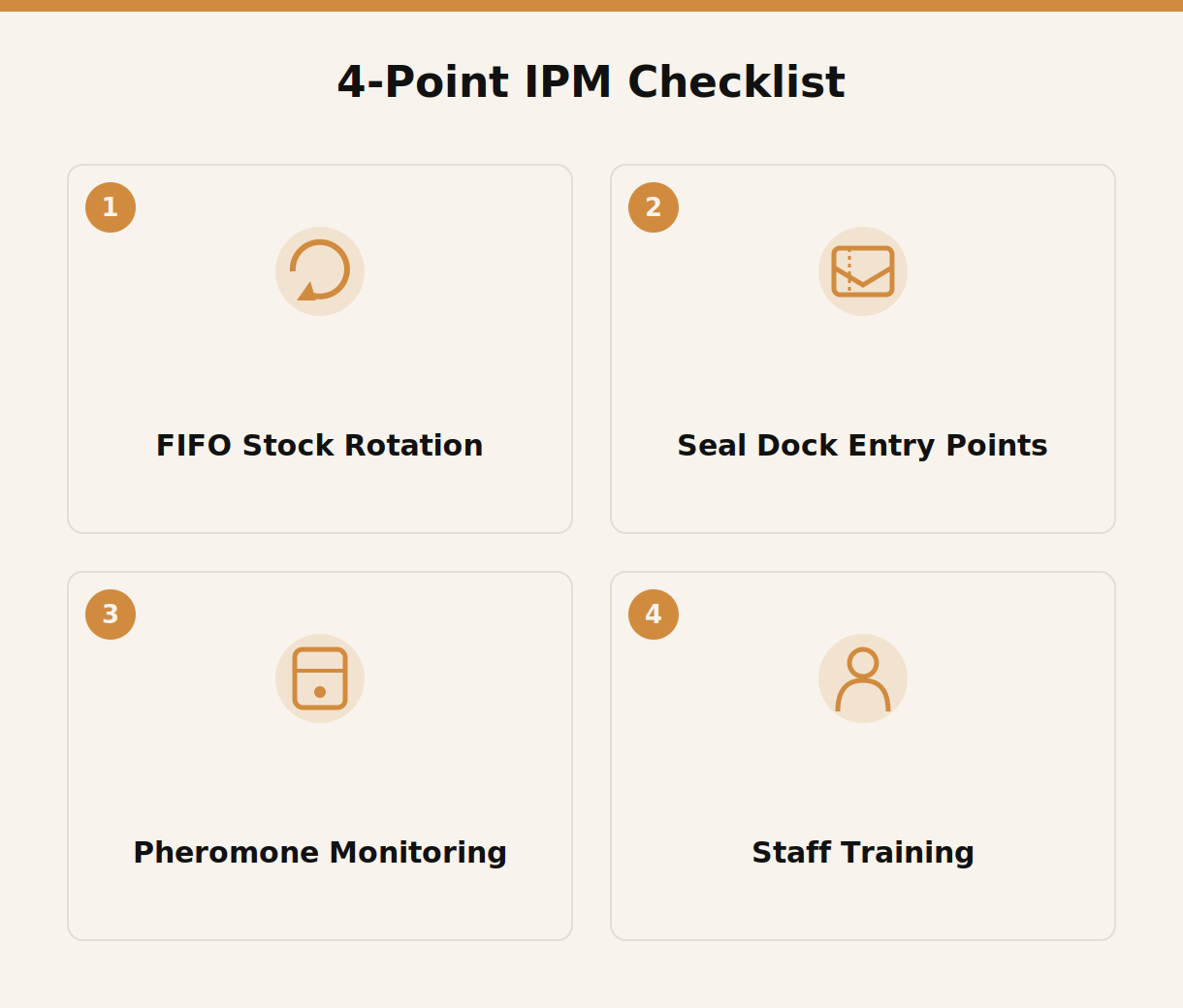
Because bulk stock is stored densely and often stacked beyond easy visual reach, warehouses need a monitoring system rather than relying on staff to spot an infestation by eye. Pheromone traps placed strategically through storage zones and near loading docks are the standard tool for catching early activity in stored product pests, since they detect adult moths and beetles before a visible population builds up in the stock itself. Regular, documented trap checks give facility managers an early signal to isolate an affected pallet before it contaminates surrounding inventory.
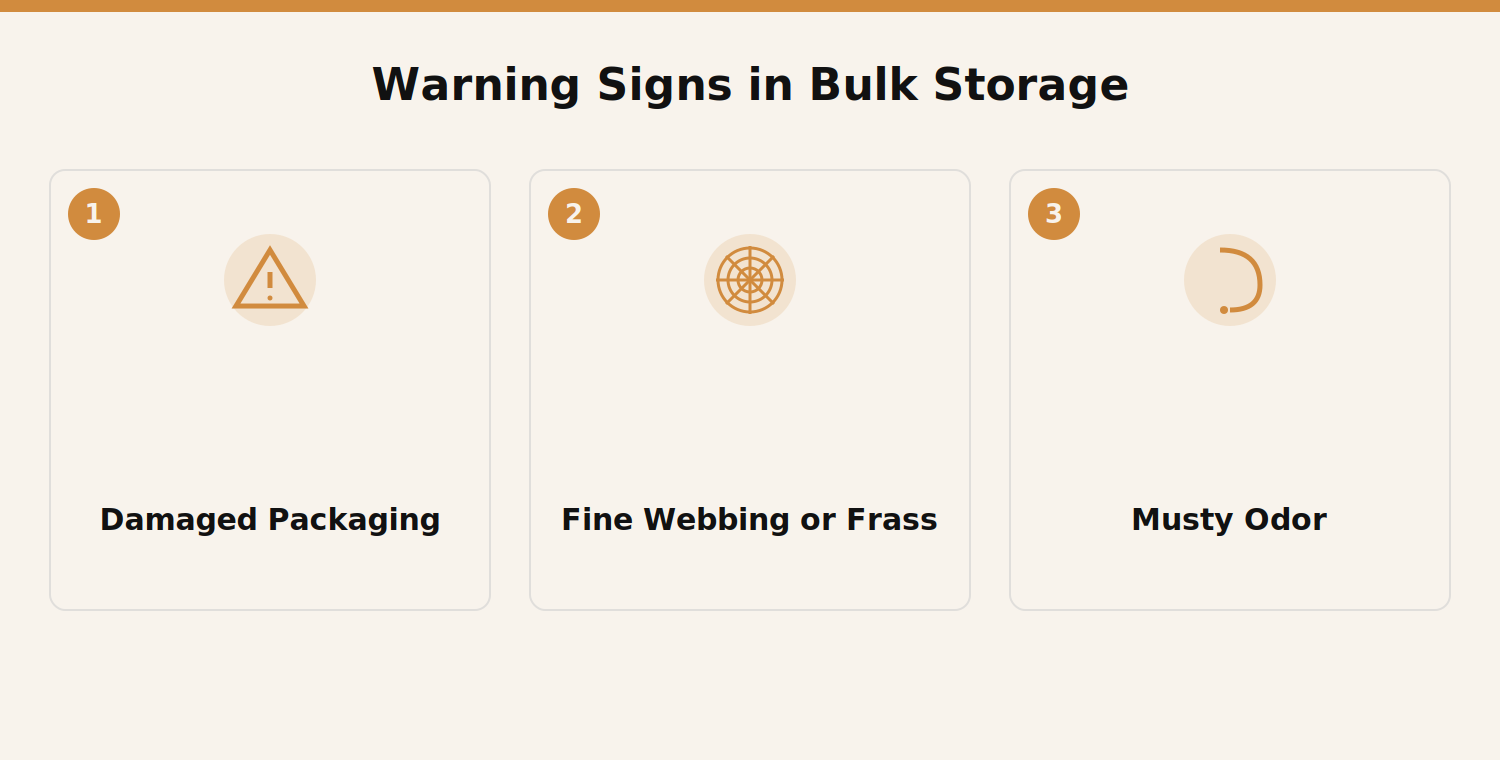
An integrated pest management approach for a Dubai warehouse combines several practical measures rather than a single treatment. Strict FIFO (first in, first out) stock rotation limits how long any single batch sits in storage, reducing the window in which a hidden infestation can establish and spread. Sealing gaps around dock levelers, doors, and wall penetrations closes off the routes stored product pests use to enter from outside. Just as importantly, training staff who receive incoming goods to recognize the early signs, damaged packaging, fine webbing, small holes in cartons, or a musty odor, means suspect pallets get quarantined before they reach general storage.
Santera has supported Dubai's commercial and logistics sector with pest control for over 25 years of team experience, and our technicians are Dubai Municipality certified to work across warehouse and distribution environments. We have completed more than 10,000 successful treatments across Dubai, and we hold a 4.9-star rating on Google Reviews from commercial and residential clients alike. For a warehouse operator, that means an inspection and monitoring program built specifically around bulk storage, loading dock exposure, and the documentation a 3PL client or food safety auditor may request, backed by a 30-day warranty with follow-up support. For a closer look at how weevils, beetles, and moths behave and spread, see our Pest Library page on stored product pests.
Once weevils, beetles, or moths establish themselves in a single pallet, they can spread to adjacent stock within weeks, especially in Dubai's warm ambient temperatures, which accelerate breeding cycles. Bulk storage means one infested consignment can put an entire zone of a warehouse at risk before staff notice any visible sign.
Spot treatment by untrained staff rarely reaches larvae hidden inside packaging, pallet timber, or product itself, and it does not address the source of entry. For 3PL and distribution operators, an undocumented in-house response can also break the chain of custody a client or food safety auditor expects to see.
Facilities handling bulk food, grain, or dry goods generally benefit from scheduled monitoring rather than a one-off visit, since new pallets and shared loading docks introduce fresh risk continuously. A recurring inspection and trap-monitoring schedule catches activity while it is still confined to a small area.
A failed audit can mean rejected shipments, contract penalties, or loss of a retail or food-service client relationship. Having a documented, Dubai Municipality-certified pest control program in place gives 3PL operators evidence of due diligence and a faster path back to compliance.
If your warehouse or distribution center handles bulk food, grain, or dry-goods inventory, protecting it from stored product pests protects your client contracts as much as your stock. Book your complimentary inspection via WhatsApp, same-day service available across Dubai, and let our Dubai Municipality-certified team build a monitoring and prevention plan around your facility.