Silverfish
Silverfish Control for Dubai Hotels: Protecting Guest Rooms, Libraries and Linen Storage
Muhammad Saif Ullah
September 15, 2026


A four or five star property in Dubai runs on guest trust, and few things erode it faster than a small, fast-moving silver insect darting out of a wardrobe drawer or a stack of hotel stationery. Silverfish are not a health hazard the way bed bugs or rodents are, but for a hotel they are a reputational one. They thrive on exactly the materials a hospitality property keeps in abundance, starched linen, book-bound libraries, paper directories, wallpaper paste, and the humid air trapped behind built-in furniture. Dubai's climate does the rest, with high ambient humidity for much of the year and air-conditioned interiors that condense moisture in closets, service ducts and back-of-house corridors. This guide sets out where silverfish actually establish inside a Dubai hotel and how an integrated approach keeps guest-facing areas, libraries and linen storage silverfish-free without disrupting operations.
Silverfish need three things to establish: moisture, warmth, and a starch or cellulose food source. A Dubai hotel supplies all three at scale. Central air conditioning keeps rooms at a stable, silverfish-friendly temperature year-round, while humidity control is rarely as tight on individual floors as it is in the main lobby, especially in older wings. Add the volume of paper and starched fabric a hospitality operation holds, room directories, menus, library books, wallpaper, upholstery backing, and hotels present a far richer feeding ground than a typical home. Where a villa might have one linen cupboard, a mid-sized Dubai hotel has several floors of housekeeping stores, a laundry processing tonnes of fabric weekly, and archive rooms holding years of paper, each a potential harborage if humidity is not managed.
The built-in wardrobe is the most common guest-facing complaint point in Dubai hotels. These units typically sit flush against an exterior or bathroom wall, and the enclosed, low-airflow space behind the back panel condenses moisture from the room's air conditioning cycle. Starched linen liners, cardboard shelf inserts and paper laundry bags inside the wardrobe give silverfish a food source metres from where a guest opens the door. Because the insects are nocturnal and avoid light, they are rarely seen by housekeeping during a standard turnover clean, only by a guest at night. Addressing this means inspecting behind fitted units, not just wiping visible shelving, and correcting the humidity buildup at its source.
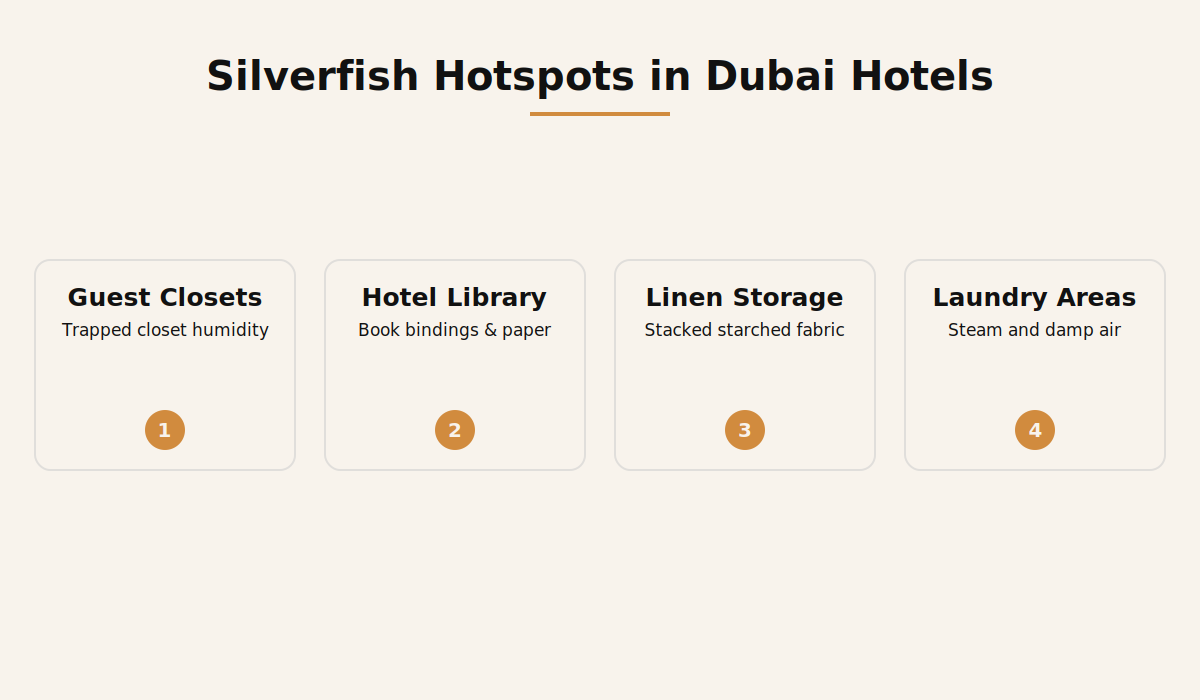
Many Dubai hotels maintain a library corner, a guest business centre, or archived paper records, and these are classic silverfish habitats. Book bindings, glue and paper are a preferred food source, and a room that is climate-controlled but rarely disturbed, with shelves untouched for months, gives an established population time to grow unnoticed. For a hotel this matters twice over: damage to books and printed collateral is a direct cost, and a guest browsing the library who encounters an insect carries that impression straight into a review. Regular shelf rotation, humidity monitoring, and periodic professional inspection catch early activity before it becomes visible.
Linen stores hold exactly the conditions silverfish favour: stacked fabric, limited air movement, and proximity to laundry humidity. In a busy Dubai property, linen rooms often sit adjacent to the laundry itself, so residual steam and damp air migrate into storage even with independent air conditioning, and the starch used in professional linen finishing is itself an attractant. Because the laundry is the humidity engine of the property, and back-of-house corridors around it often run damper than guest-facing floors, silverfish can travel from the laundry into linen stores, staff areas and service risers largely unnoticed, since this zone is guest-invisible and easy to overlook during routine cleaning.
Unlike a residential sighting, a hotel incident rarely stays private. A guest who finds an insect in their room has an immediate, visible channel, a review platform, a social post, a comment to the front desk, and hospitality-sector hygiene standards mean even a non-hazardous pest sighting is typically logged as a service failure during internal quality audits. For Dubai properties competing on guest satisfaction scores, the cost of an unresolved silverfish issue is measured in review damage and repeat-guest confidence. Treating silverfish control as part of routine hygiene compliance, rather than a reactive response to a single complaint, protects both the guest experience and the property's audit history.
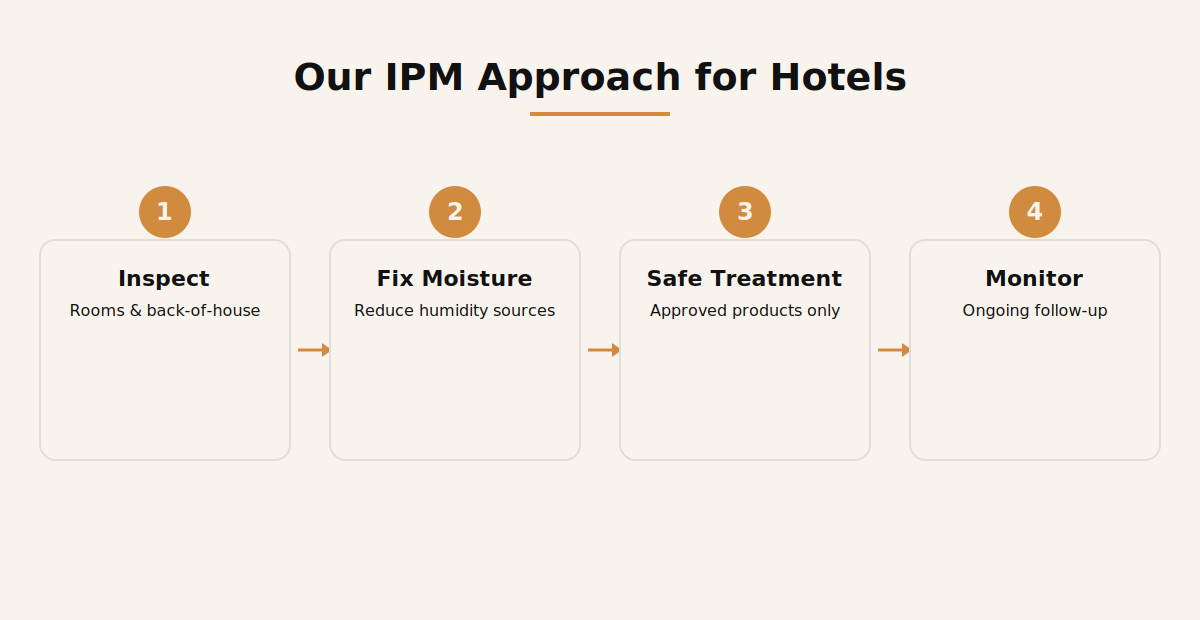
Effective silverfish management in a Dubai hotel is built on integrated pest management (IPM) rather than a single treatment visit. That means correcting the moisture sources that let silverfish establish, humid wardrobe cavities, under-ventilated linen stores, laundry-adjacent corridors, alongside targeted, Dubai Municipality-approved professional products applied to harborage points such as skirting, closet backs and library shelving. Monitoring stations placed discreetly in back-of-house areas and library corners let our technicians track activity over time rather than treating once and hoping it holds. Because this is a hospitality environment, every visit is scheduled around occupancy and coordinated with your engineering or housekeeping team, so guest rooms and public areas stay fully in service throughout.
A single treatment addresses an active population, but Dubai's humidity means the underlying conditions that attract silverfish do not disappear on their own. Our approach for hotel clients includes a 30-day warranty with follow-up support, so any recurring activity in the weeks after treatment is addressed without a fresh call-out, plus practical recommendations your facilities team can act on, adjusting extraction in laundry areas, sealing gaps behind fitted wardrobes, and rotating library stock periodically. Santera's team draws on 25+ years of combined pest control experience across Dubai's hospitality sector, is Dubai Municipality certified, and has completed 10,000+ successful treatments, reflected in a 4.9 star rating on Google Reviews from clients including hotel and facilities managers.

Wardrobes hold two things silverfish need: still, humid air and starch-sized fabric or paper liners. A wipe-down of visible surfaces does not change the humidity trapped behind the back panel or the moisture that Dubai's air conditioning cycles leave in enclosed cabinetry. Until the humidity and the hidden starch sources are addressed, cleaning alone will not stop new sightings.
Yes. A guest who finds a silverfish in a wardrobe or bathroom rarely distinguishes it from a more serious infestation, and the resulting review or in-stay complaint reads the same either way. For hotels tracked on online reputation scores and periodic hygiene audits, a handful of documented sightings can affect both guest satisfaction metrics and internal compliance standing.
No. Treatment is planned around occupancy, typically targeting closets, skirting, linen rooms and back-of-house storage during turnover windows or low-occupancy periods, so guest rooms stay in service. Your engineering or housekeeping team coordinates access with our technicians room by room.
Same-day service is available across Dubai for confirmed sightings, and our team can inspect the affected room plus adjoining storage and plumbing chases the same day a report comes in, so the issue is contained before it reaches a review.
Protecting your guest experience starts with knowing exactly where silverfish are establishing in your property, and that starts with an inspection, not a guess. Learn more about this pest on our silverfish pest library page, and when your hotel is ready for an assessment, our Dubai Municipality certified team is ready to help. Book your complimentary inspection via WhatsApp, same-day service available across Dubai.