Scorpions
Scorpion Control for Dubai Warehouses and Industrial Storage Facilities: Protecting Staff on Loading Docks and Ground-Level Storage
Muhammad Saif Ullah
September 15, 2026


A forklift operator reaches under a pallet that has not been moved in three weeks and feels a sharp sting across the back of the hand. A night-shift picker unboxing stock near a loading dock roller shutter finds a scorpion tucked against the door track. For facility managers running warehouses and industrial storage sites across Dubai, these are not freak incidents. They follow directly from how ground-level storage is built and used: concrete floors with expansion gaps, pallet stacks left untouched for weeks, dim loading dock corners, and long overnight shifts when scorpions are most active. This guide sets out where scorpions turn up inside Dubai's warehousing and industrial districts, why, and what a safety-conscious facility manager should put in place to protect staff.
Scorpions in Dubai favour dry, dark, undisturbed spaces close to a reliable source of insect prey, and the industrial zones around Jebel Ali, Al Quoz, National Industries Park, and similar warehousing districts sit right at the edge of this habitat. Large ground-floor buildings with concrete slab flooring, roller shutter doors that rarely seal completely, and stock that can sit for weeks between movements create exactly the sheltered conditions scorpions look for. None of this reflects poorly on a facility's housekeeping standards; it is simply a function of scale, since a warehouse has far more quiet, low-traffic floor space than a typical commercial unit. Dubai's desert-adjacent climate, warm for most of the year, keeps scorpions moving toward cooler indoor shelter, so the risk applies across the industrial calendar, not just in summer.
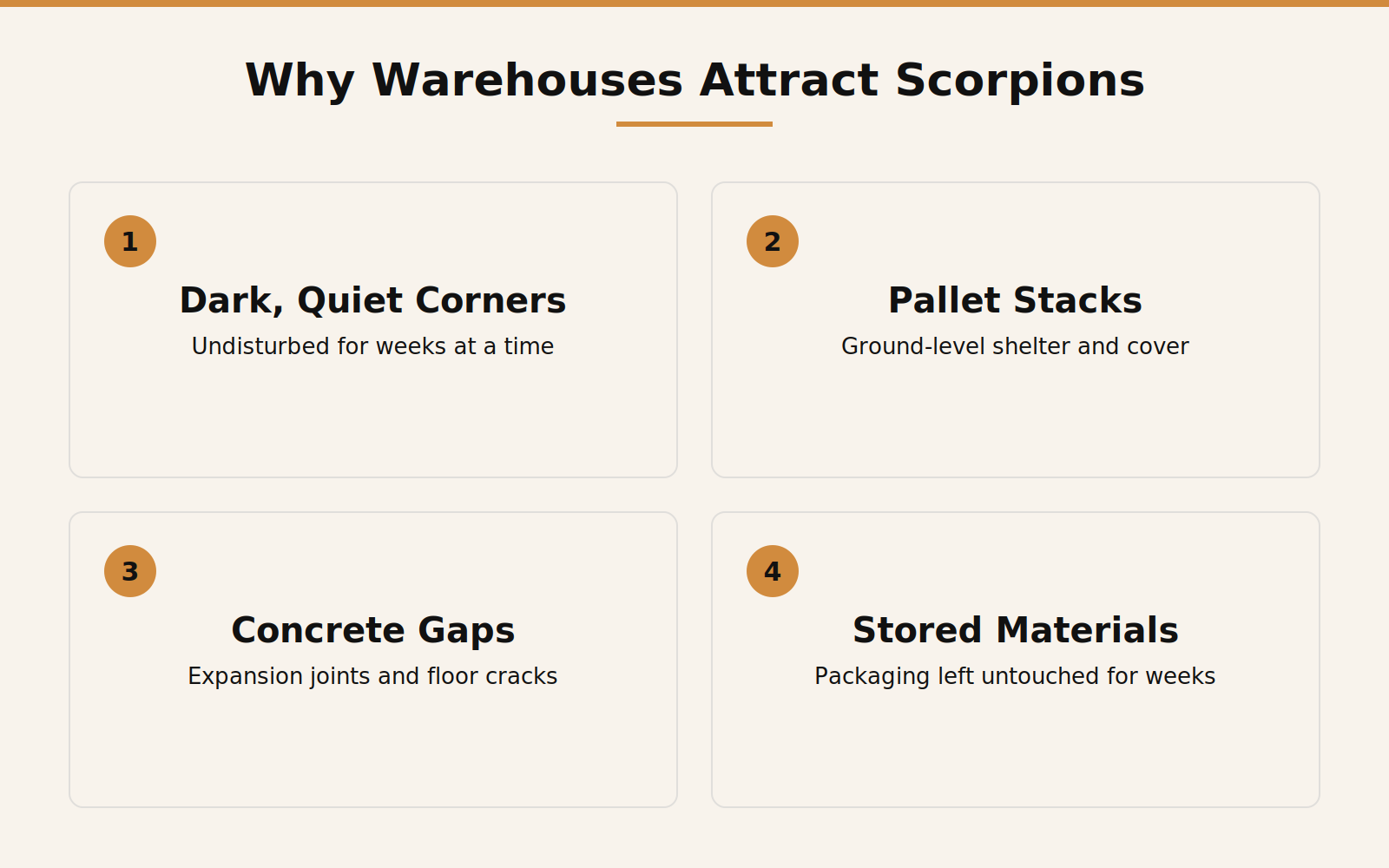
Pallet stacks recreate the same sheltered, undisturbed conditions scorpions seek under rocks or rubble outdoors. A pallet sitting in a back corner for several weeks, or seasonal stock waiting out a slow period, gives a scorpion exactly the quiet, dark space it needs. Risk rises with how long inventory sits still: fast-moving stock near dispatch turns over constantly and offers little chance for a scorpion to settle, while slow-moving storage further back can go unchecked for long stretches. Staff who reach quickly under a pallet, lift a tarp, or unbox stock untouched for weeks are the people most likely to have an unexpected encounter.
Loading docks combine several risk factors in one place. Roller shutters and dock levellers create gaps at floor level that are difficult to seal completely, dock edges and bumper pads offer sheltered voids, and the area sees constant staff movement at the exact hours, early morning and late evening, when scorpion activity peaks. A scorpion sheltering near a dock leveller or behind a stack of returned pallets is well placed to encounter a staff member loading a truck, checking in a delivery, or clearing debris at the end of a shift.
Large industrial slabs are built with expansion joints, and over time, floor cracks, gaps around drainage channels, and voids where flooring meets a wall or column base can develop. These small, dark gaps are ideal scorpion harbourage and are easy to overlook during a routine walk-through, since they blend into the concrete and rarely draw attention until someone is reaching or kneeling nearby. Facilities with older flooring, or sections that have seen recent construction or repair work, warrant particular attention here.

Scorpion activity rises sharply around dawn and dusk and continues overnight, which lines up directly with night-shift picking, early loading schedules, and closing routines common across Dubai's logistics operations. Staff opening a storage bay before sunrise, or closing up a facility after exterior lighting has dimmed, are working during exactly the hours scorpions are moving and hunting. This is also when visibility is lowest and reaching into low storage or under pallets happens with the least ability to spot a scorpion first.
Building this into an existing HSE program keeps the responsibility with facility managers who already own staff safety across the site. For background on the species, Santera's scorpion pest library page is a useful reference for onboarding.
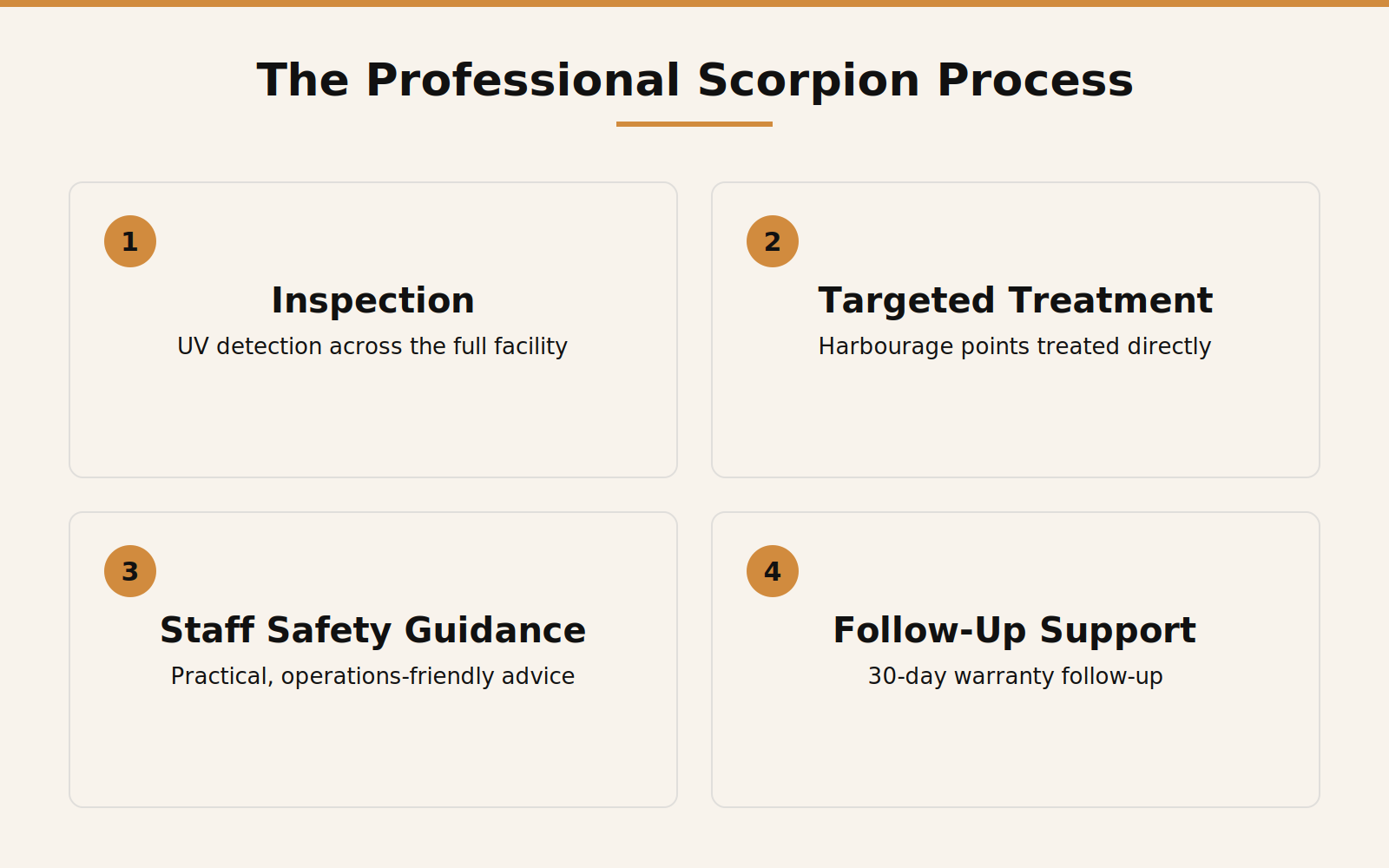
A proper response starts with a complimentary inspection covering pallet storage, loading docks, and floor-level gaps, using UV detection, since scorpions glow distinctively under UV light and are otherwise easy to miss against concrete and packaging. Santera then treats identified harbourage points directly and provides practical, operations-friendly recommendations on storage rotation and dock housekeeping that reduce future risk without disrupting throughput. The team is Dubai Municipality certified, rated 4.9 stars on Google Reviews, and brings 25+ years of team experience across more than 10,000 successful treatments, with 24/7 availability and same-day service across Dubai. Every treatment includes a 30-day warranty covering follow-up support for continued activity of the same pest within the agreed scope; it excludes new infestations, reintroduction from an untreated area, and structural issues outside the treatment scope.
Most scorpion species encountered in Dubai's industrial areas cause pain comparable to a bee sting, but the Arabian fat-tailed scorpion is more dangerous and any sting from it should be treated as a medical concern. Because staff cannot reliably identify the species in the moment, every sting on a warehouse floor should be treated with caution, and prompt medical attention sought where symptoms are more than mild.
Ground-level pallet stacks, loading dock edges, gaps in concrete flooring, and stored materials or packaging left undisturbed for weeks carry the highest risk. Seldom-moved inventory near external walls and roller shutters is a particular concern because it combines shelter with proximity to the outside.
Scorpions are most active around dawn and dusk and overnight, which overlaps directly with night-shift operations, early loading schedules, and warehouse closing routines. Activity also tends to pick up in warmer months, though facilities near open desert-adjacent land can see scorpions year-round.
A periodic professional inspection, paired with a routine staff visual check of pallet stacks and loading dock areas, gives most warehouses reliable coverage. Facilities with frequent pallet turnover, seasonal storage builds, or nearby vacant land benefit from more frequent attention.

Scorpion risk inside a Dubai warehouse or industrial storage facility is manageable once pallet rotation, loading dock housekeeping, and floor-level maintenance get the same attention as any other staff safety item. Santera provides Dubai Municipality certified scorpion inspection and treatment for warehouses and industrial storage sites across Dubai, using UV detection to locate harbourage in pallet stacks, dock areas, and concrete gaps before it becomes a staff injury report. Book your complimentary inspection via WhatsApp, same-day service available across Dubai.