Scorpions
Scorpion Control for Dubai Hotels: Pool Decks, Grounds and Back-of-House
Muhammad Saif Ullah
September 19, 2026


A cabana attendant folding towels at dusk finds a scorpion tucked into the base of a sun lounger. A gardener clearing a planting bed along the driveway disturbs one sheltering under mulch. A steward pulling linen from a ground-level store gets a scorpion crossing the floor in front of them. None of these are guest-room incidents, but any one of them can become a guest-safety question or a staff injury report if a property is not prepared. Dubai's scorpion conversation usually centres on villas and gardens, but hotels sit on exactly the same terrain: landscaped grounds, pool decks that go quiet after sunset, and back-of-house storage that mirrors the dark, undisturbed spaces scorpions favour. This guide covers where scorpions turn up on a Dubai hotel property, the guest-safety protocol front-of-house and grounds teams should follow, and what staff training and professional support should look like.
Scorpions in Dubai, including the Arabian fat-tailed scorpion, favour dry, dark, sheltered spots close to a reliable source of insect prey, and they are most active around dawn and dusk. A hotel property brings several of these conditions together at scale: extensive landscaped grounds, pool and cabana areas that see heavy daytime use but sit quiet and dimly lit in the evening, and back-of-house zones with the kind of stacked, undisturbed storage a scorpion will happily shelter in. None of this reflects on a property's standards; it is simply Dubai's climate and terrain meeting a large, landscaped footprint. For background on the species, see Santera's scorpion pest library page.
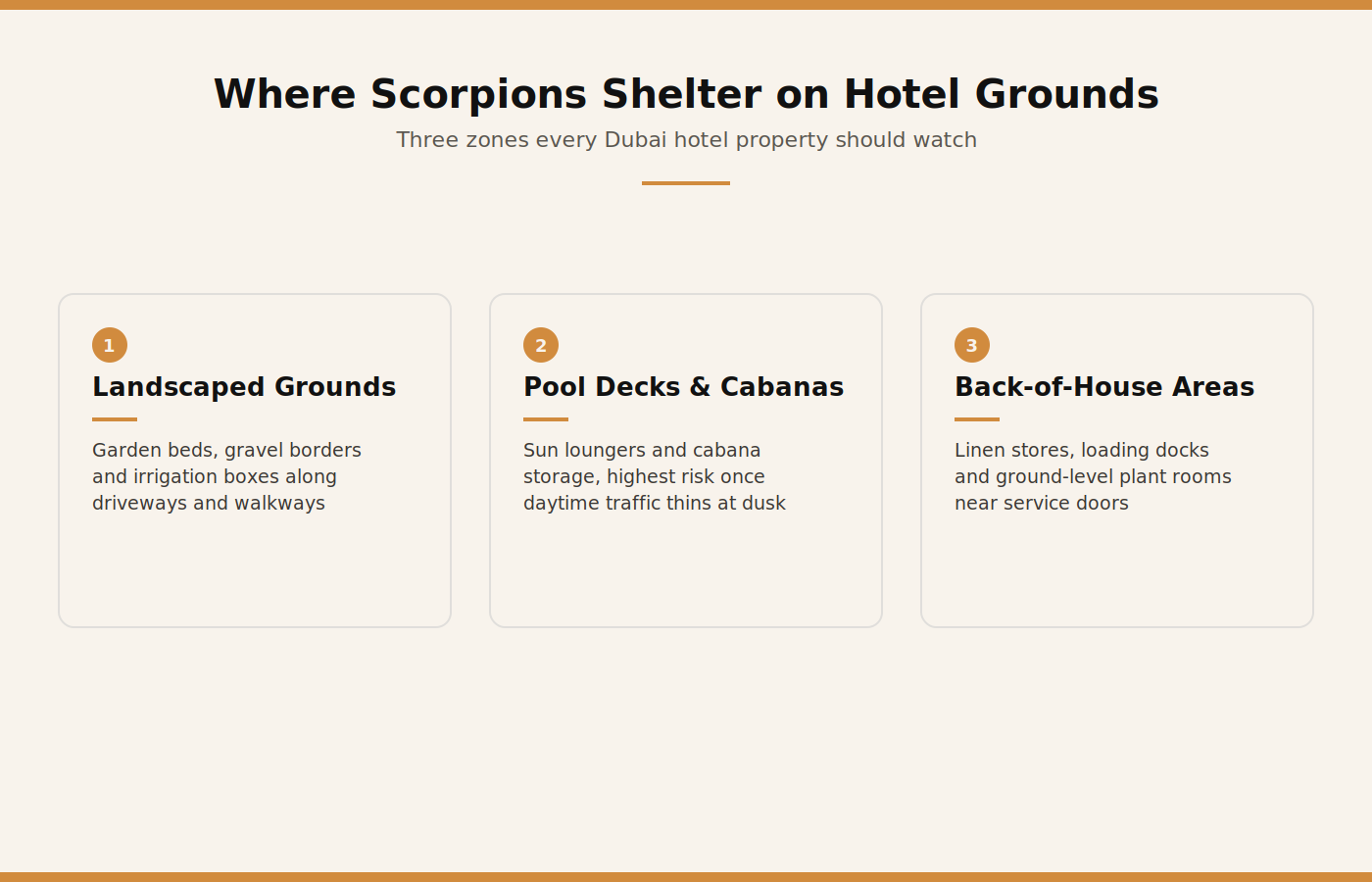
Ornamental planting beds, decorative gravel borders, irrigation boxes and mulch along driveways and walkways recreate the exact sheltered conditions scorpions seek in the wild. Hotel grounds are often larger and more elaborately landscaped than a typical villa garden, which means more edge habitat bordering paths, entrances and service doors. Grounds staff maintaining these beds, and any guest walking a garden path after dark, are the people most likely to have an unplanned encounter.
Pool decks, sun loungers and cabana storage sit close to landscaping and often have soft furnishings, folded towels and storage boxes that scorpions can shelter under during the day. The risk window widens sharply at dusk, once daytime pool traffic thins out but before evening lighting and staff presence pick back up. This is precisely when a scorpion sheltering nearby is most likely to be moving, and precisely when a returning guest or a closing cabana attendant is least likely to be checking for one.
Linen stores, loading docks, ground-level plant rooms and stacked supply areas in the back-of-house corridor share the same dark, undisturbed conditions as any warehouse storage area. Deliveries arriving through loading bays, boxes sitting for days between use, and gaps around service doors all give a scorpion a route in and a reason to stay. Staff working these areas, often during early or late shifts, face similar exposure to grounds and pool staff, just in a different part of the property.

A clear, calm protocol matters more than speed. If a guest reports a scorpion, staff should move the guest away from the area without alarm, avoid handling the scorpion directly, and note the exact location as precisely as possible, whether that is a specific lounger, a garden bed, or a spot near a guest room entrance. That location detail is what allows a property to tell the difference between an isolated one-off entry point and a pattern worth investigating further. Guests should never be told to handle or remove a scorpion themselves, and staff should follow the same rule.
Because scorpion risk touches several departments at once, training works best when it is shared rather than siloed. Housekeeping and turndown staff benefit from knowing what to do if a scorpion turns up in a guest room. Grounds and pool teams benefit from torch checks before reaching into planting beds, cabana storage or lounger frames during early or late shifts. Security and duty managers benefit from a simple, documented reporting line so every sighting reaches the same place and a pattern can be tracked across the property rather than staying anecdotal within one team.
A proper response starts with a complimentary inspection covering landscaped grounds, pool and cabana areas, and back-of-house storage, using UV detection, since scorpions glow distinctively under UV light and are otherwise easy to miss against gravel, concrete or storage boxes. Santera then treats identified harbourage directly and provides practical guidance on landscaping maintenance, storage habits and entry-point sealing that a large property can build into its routine grounds and facilities schedule. The team is Dubai Municipality certified, available 24/7 with same-day service across Dubai, and backed by 25+ years of team experience, a 4.9-star Google rating, and more than 10,000 successful treatments. Every treatment includes a 30-day warranty covering follow-up support for continued activity of the same pest within the agreed scope.

Most scorpion species encountered around Dubai properties cause pain comparable to a bee sting, but the Arabian fat-tailed scorpion is more dangerous and any sting from this species should be treated as a medical concern. Because guests and staff cannot reliably identify the species in the moment, hotels should treat every sting as a matter for prompt medical attention rather than something to assess on-site.
Landscaped grounds and garden beds bordering the building, pool decks and cabana storage, and back-of-house areas such as loading docks, linen stores and ground-level plant rooms are the highest-risk zones. Guest rooms are a much lower risk when perimeter and back-of-house harbourage is properly managed.
Move the guest calmly, avoid handling the scorpion directly, note the exact location, and contact the property's pest control provider rather than attempting removal. Documenting where the sighting occurred helps identify whether it is an isolated entry point or part of a wider pattern from grounds or back-of-house harbourage.
A recurring professional inspection schedule covering grounds, pool areas and back-of-house zones, paired with daily staff visual checks in high-risk areas, gives hotels the most reliable coverage. Properties with extensive landscaping or golf-course-adjacent grounds benefit from more frequent perimeter attention.
No. Scorpions are drawn to shelter, darkness and insect prey rather than to poor housekeeping, and Dubai's climate and terrain put every ground-floor property near landscaping at some level of risk. What matters is how quickly and professionally a property responds, not that a sighting occurred at all.

Scorpion risk on a Dubai hotel property is manageable once landscaped grounds, pool and cabana areas, and back-of-house storage get the same structured attention as any other guest and staff safety item. Santera provides Dubai Municipality certified scorpion inspection and treatment for hotel properties across Dubai, using UV detection to locate harbourage across grounds, pool areas and back-of-house zones before it becomes a guest or staff incident. Book your complimentary inspection via WhatsApp, same-day service available across Dubai.