Rodents
Rodent Control for Dubai Offices and Commercial Buildings: Protecting Server Rooms, Pantries and Shared Tenancies
Muhammad Saif Ullah
September 13, 2026


A rodent problem in a Dubai office tower rarely stays confined to one tenant's floor for long. Shared service risers, cable routes and parking structures give rats and mice a way to move between floors and businesses largely unnoticed, until someone finds droppings in a pantry cupboard or an IT team is troubleshooting a cable fault that turns out to be gnaw damage. For facility managers running multi-tenant commercial buildings, rodent control is a building-wide responsibility, not a single office's cleaning issue.
Commercial buildings combine several conditions that suit rodents well. Underground parking and loading docks offer sheltered, low-traffic entry points at ground level, while service risers and cable ducts run vertically through the entire structure, connecting floors that otherwise have nothing to do with each other. Shared pantries, cafeterias and waste rooms provide a steady food source, and after hours, when a tower is quiet and mostly empty, rodents can move through common areas with little disturbance.
Rodents typically enter through gaps around loading dock doors, utility penetrations at ground level, or parking ramp entrances that are difficult to fully seal. Once inside, they travel through service risers, cable routes between floors and the void space above false ceilings, which is why activity can appear on a floor with no obvious food source at all. Waste and recycling rooms near the loading dock are another common travel hub, especially where bins are not tightly sealed between collections.
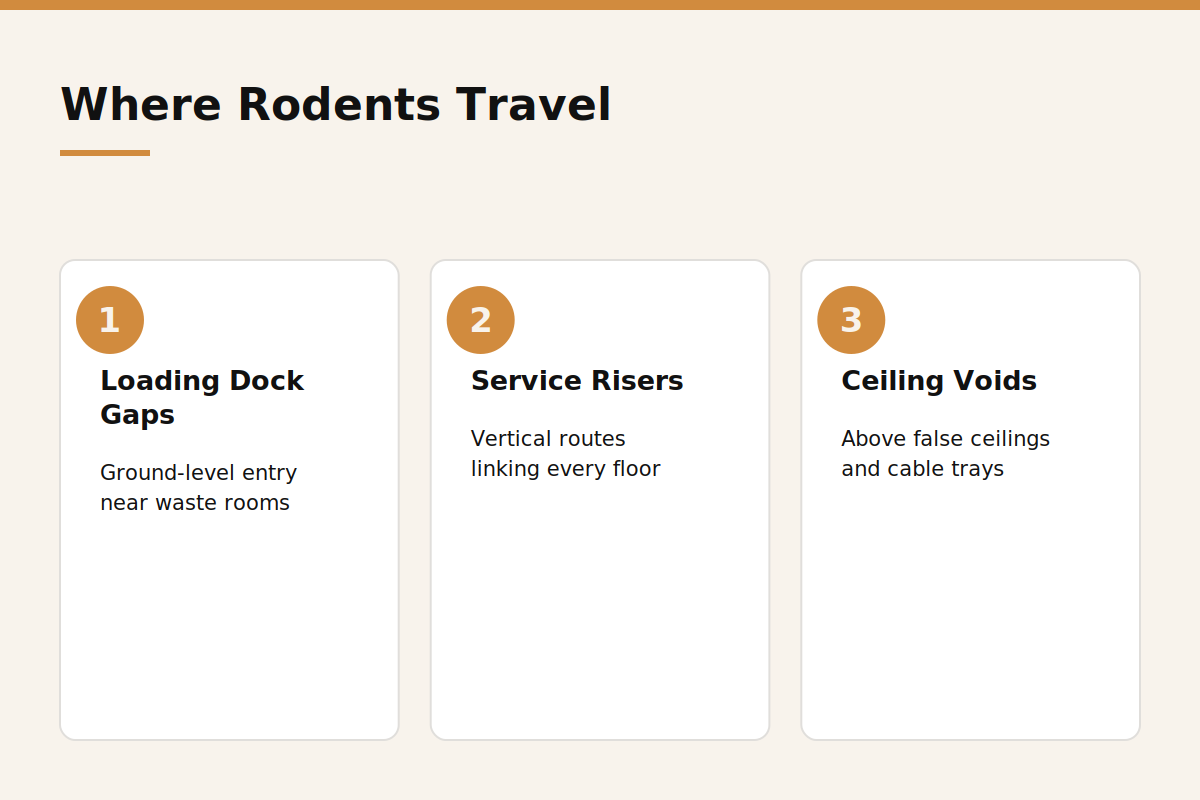
Because service risers and ceiling voids run through the whole structure, a rodent population that establishes itself near one tenant's space is rarely limited to that space for long. An office that ignores early signs, assuming it is a neighboring tenant's problem to solve, can unintentionally let a population grow large enough to affect several floors. This is one of the main reasons building management and individual tenants generally get better results by coordinating on rodent control rather than each handling it in isolation.
Rodents gnaw on cabling to keep their teeth in check, and a server room or comms closet with dense, undisturbed cable runs is a prime target. The result can be intermittent network faults that take an IT team hours to trace back to physical damage. In pantries and shared kitchens, droppings and gnawed packaging raise hygiene concerns that facility management has to answer for during any tenant walkthrough or compliance review. None of these issues tend to improve on their own, and each week of delay generally means more areas affected.
The earliest signs are often small and easy to dismiss. Droppings inside pantry cupboards or storage rooms, gnaw marks on cardboard or cable insulation, scratching or movement sounds in ceiling voids after hours, and damaged packaging in storage areas are all worth reporting immediately rather than waiting to see if they recur. Facility teams that log these signs and act quickly typically resolve activity before it spreads to additional floors.

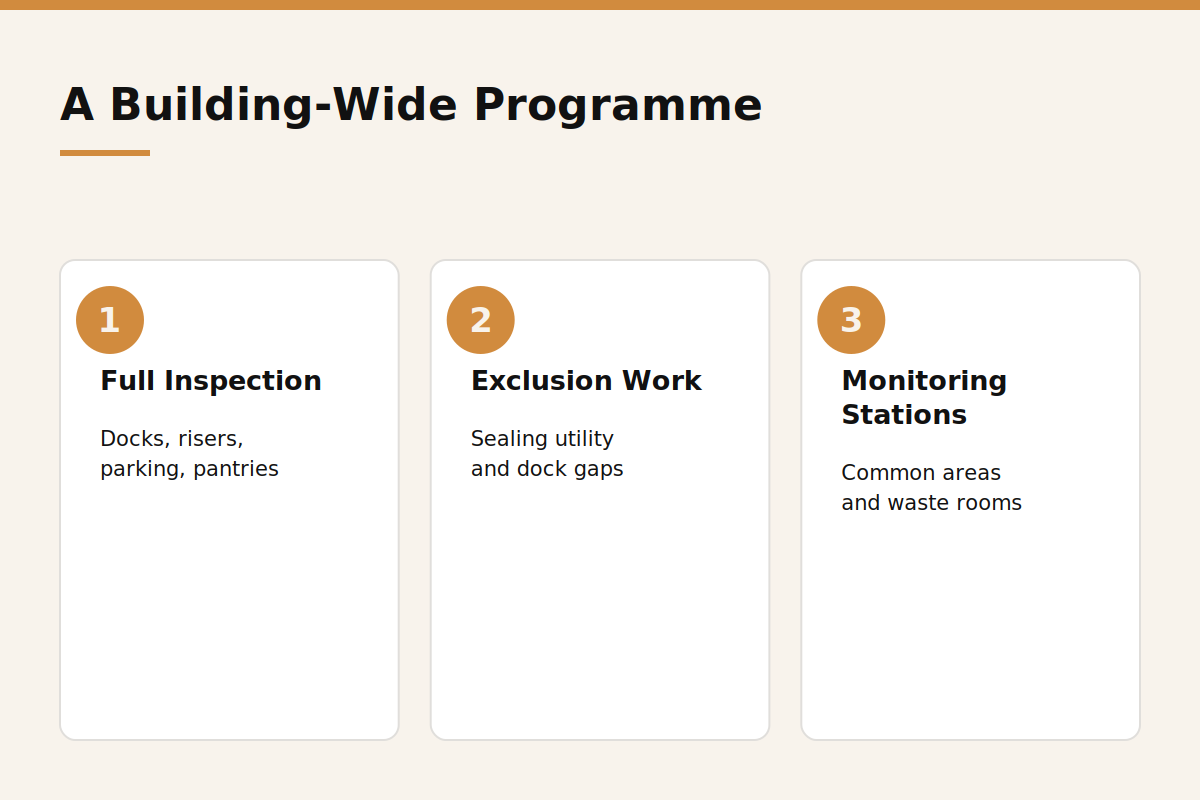
An effective commercial programme starts with a full inspection covering loading docks, parking structures, service risers, ceiling voids and common-area pantries, not just the floor where activity was reported. A Dubai Municipality certified technician then focuses on excluding entry points, sealing gaps around utility penetrations and loading dock doors, alongside discreet monitoring stations placed in common areas, risers and waste rooms. Because a commercial building operates continuously, this work is scheduled to avoid disrupting tenants, with clear reporting shared with facility management so any new activity is caught early.
Rodents need less food than most tenants assume. Pantry crumbs, cafeteria waste, and even cardboard or paper for nesting are enough to sustain them, and a multi-tenant tower offers shelter in service ducts and false ceilings that few people ever inspect.
Yes. Shared service risers, cable routes and ceiling voids connect floors throughout a building, so rodents entering through one tenant's space or the loading dock can travel well beyond where they were first noticed.
Rodents gnaw on cabling to manage their teeth, and server rooms with dense cable runs and quiet, undisturbed conditions are an attractive target. Chewed cabling can cause intermittent faults that are costly and time-consuming to trace.
It depends on the lease, but because rodents move through shared risers and common areas, building-wide coordination between facility management and individual tenants generally produces better results than each tenant acting alone.
Most Dubai commercial properties keep discreet monitoring stations in place year round in common areas, loading docks and risers, with scheduled checks rather than reacting only after droppings or damage are reported.
Rodents in a commercial building rarely stay a single tenant's problem for long. Santera is Dubai Municipality certified and works with facility management teams across the city to inspect, exclude and monitor multi-tenant properties from the loading dock to the server room. For more background, see our Pest Library page on rodents. To arrange a complimentary inspection for your building, reach out on WhatsApp.