Termites
Flying Termites in Dubai Villas: How to Tell Swarmers From Flying Ants and What to Do Next
Muhammad Saif Ullah
October 20, 2026


A cloud of small winged insects around a light, or a scatter of tiny wings on a window sill in the morning, is one of the clearest signals a Dubai homeowner can get. These are swarmers: young winged termites that leave a mature colony to start new ones. They appear for a short time, are drawn to light, and drop their wings within hours. Not every winged insect indoors is a termite, and the difference matters, because a termite swarm means a colony is active nearby, in your garden, a neighbouring property or the villa itself. Knowing what you are looking at lets you act on the same day.
Winged ants and winged termites are easy to mix up at a glance, but three features separate them. Check the antennae, the waist and the wings:
| Feature | Flying termite | Flying ant |
|---|---|---|
| Antennae | Straight, like a string of beads | Bent, with a clear elbow |
| Waist | Thick, with no pinched waist | Narrow, pinched waist |
| Wings | Two pairs of equal length, much longer than the body | Front pair longer than the back pair |
| What it leaves behind | A pile of matching shed wings, often near light | Rarely leaves a pile of wings |
If you can catch one, look at the waist first. A thick, straight body with matching wings is a termite. If you are not sure, take a clear photo of the insect or the wings and send it to us on WhatsApp.
Swarmers head for light and open air, so the clues cluster in a few places. Check these first:
A swarm lasts a short time, so the first hour is useful:
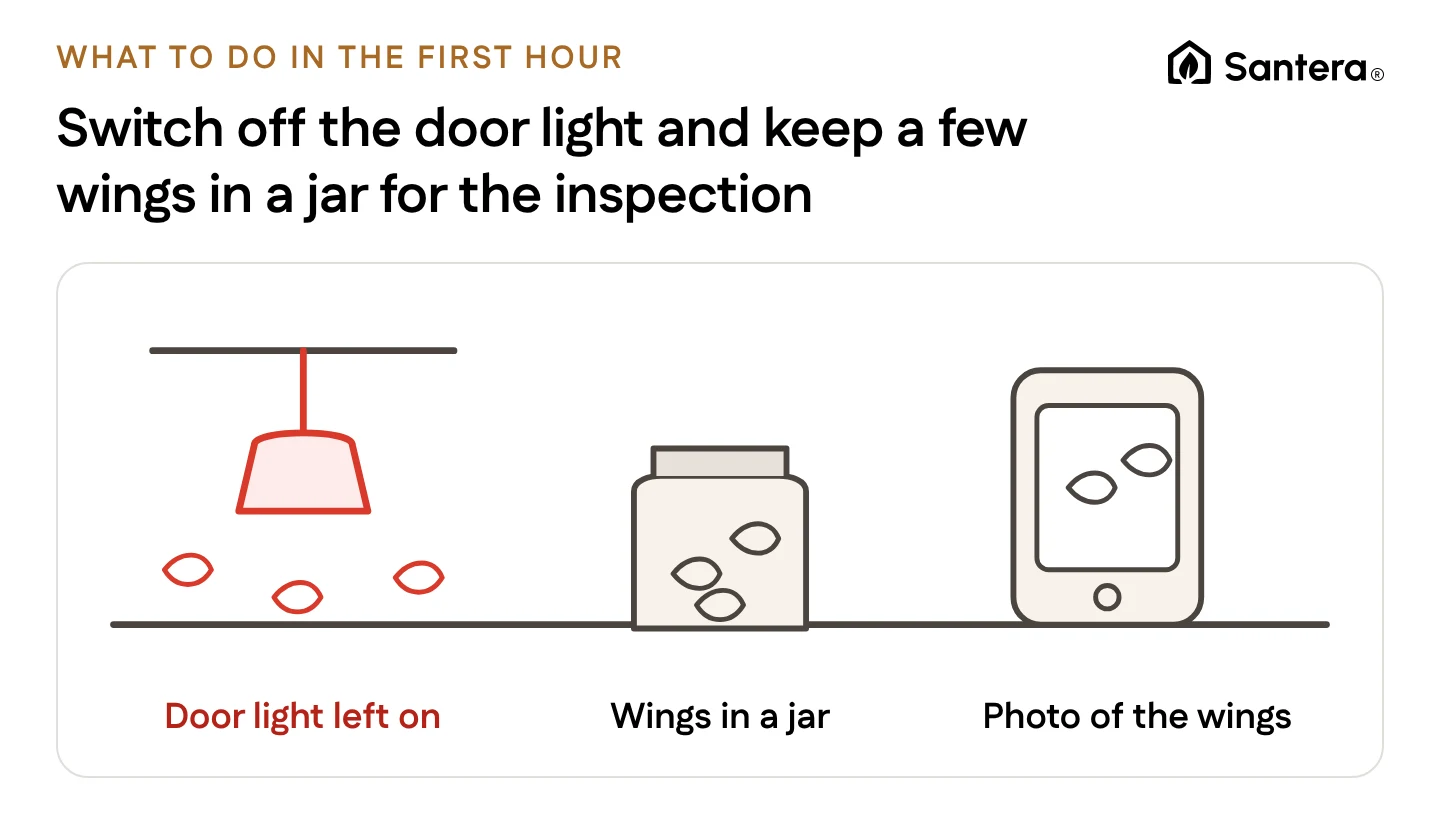
The winged insects you can see are only a small part of the picture. The colony they came from lives out of sight, in soil or in timber, and keeps feeding while you deal with the swarm. In Dubai, irrigated gardens, damp soil along villa walls and buried timber give colonies the moisture they need all year round. A single swarm can also be a sign of more activity to come, so the useful question is where the colony is, not how many wings you swept up.
Not necessarily, but a swarm inside the house deserves a closer look. A swarm in the garden or outside the walls usually points to a colony in the soil nearby. Swarmers appearing from a wall, a door frame or a floor edge point to activity close to the structure. Either way, an inspection checks the timber, the wall bases and the garden for live activity before any damage grows. For a wider look at the early signs of termite activity, see our post on early termite warning signs in Dubai homes.
Santera, Dubai Municipality certified (License 1595993), inspects the villa inside and out, finds where the colony is active and plans targeted treatment at the source, with a 30-day warranty with follow-up support. For background on these insects, visit our termites pest library page.
Flying termites do not bite or sting in the way that matters to a household. The concern is the property: a swarm shows that a mature colony is nearby, and colonies feed on timber and other cellulose materials.
Not always, but you should treat it as a reason to inspect. A swarm can come from a colony in your garden, a neighbouring property or the structure itself, so only an inspection can tell you which.
Swarmers are drawn to light. That is why they often collect at window sills, door lights and light fittings, and why shed wings turn up there the next morning.
Killing the winged insects you can see does not reach the colony they came from. Without finding and treating the source, activity usually continues, so book an inspection.
Seen flying termites or shed wings at home? Santera inspects your villa, finds where the colony is active and plans targeted treatment. Book your complimentary inspection via WhatsApp, with same-day service available across Dubai.
WhatsApp or call: +971 4 332 2623
Email: info@santera.ae
Book online: santera.ae