Centipedes & Millipedes
Centipede and Millipede Control for Dubai Retail Stores and Community Centers After Rain
Muhammad Saif Ullah
September 16, 2026


A customer photographing a centipede on the shop floor is a different problem than a homeowner finding one in the garden. In Dubai, the days after a rain event are when retail units and community centers see the sharpest spike in centipede and millipede sightings, and unlike a villa, a retail floor doesn't get to quietly deal with it after hours. Staff have to respond in real time, in full view of shoppers, while community center management fields the same complaint from three different tenants by lunchtime.
This is a distinct challenge from residential activity: the entry points are different (loading bays and shared landscaping instead of a garden bed), the stakeholders are different (facilities management and multiple tenants instead of one household), and the cost of a sighting is different (customer perception instead of a private nuisance). Here is what actually drives activity in Dubai's retail and community-center environments after rain, and how to get ahead of it.
Centipedes and millipedes are moisture-dependent. Outside of rain events, Dubai's dry climate keeps them mostly confined to irrigated landscaping, soil beds, and damp voids around drainage lines. When rain saturates the ground, it floods their usual hiding spots and pushes them to search for drier, sheltered space nearby. A retail unit or community center building, with its climate-controlled interior and multiple ground-level entry points, is exactly that shelter.
Community centers and retail strips are particularly exposed because they combine several risk factors in one site: landscaped common areas right up against the building line, multiple loading and service entrances used throughout the day, and shared drainage infrastructure that a single tenant has no control over. A retail block can have a dozen points of entry across multiple units, all connected by the same perimeter landscaping.
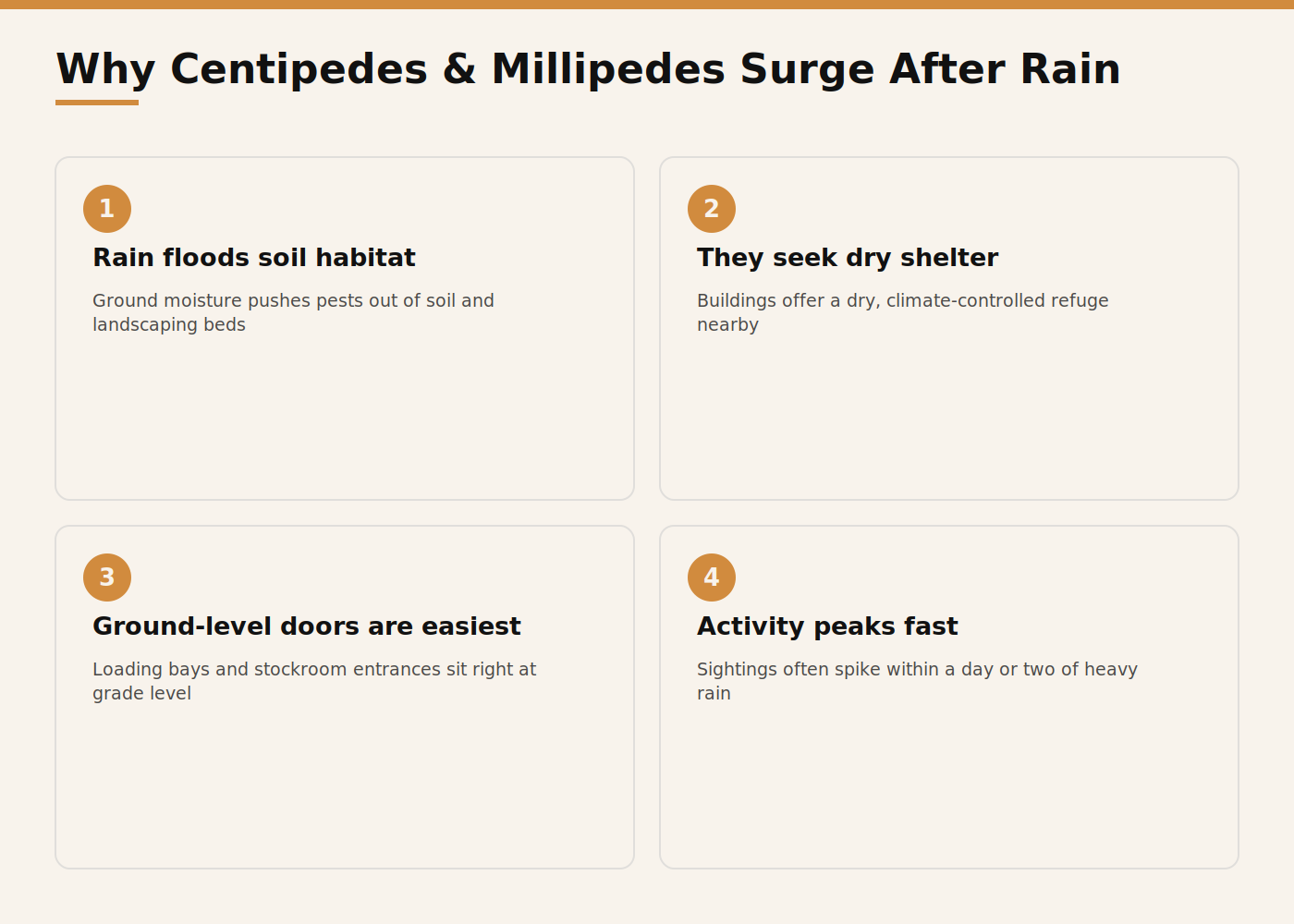
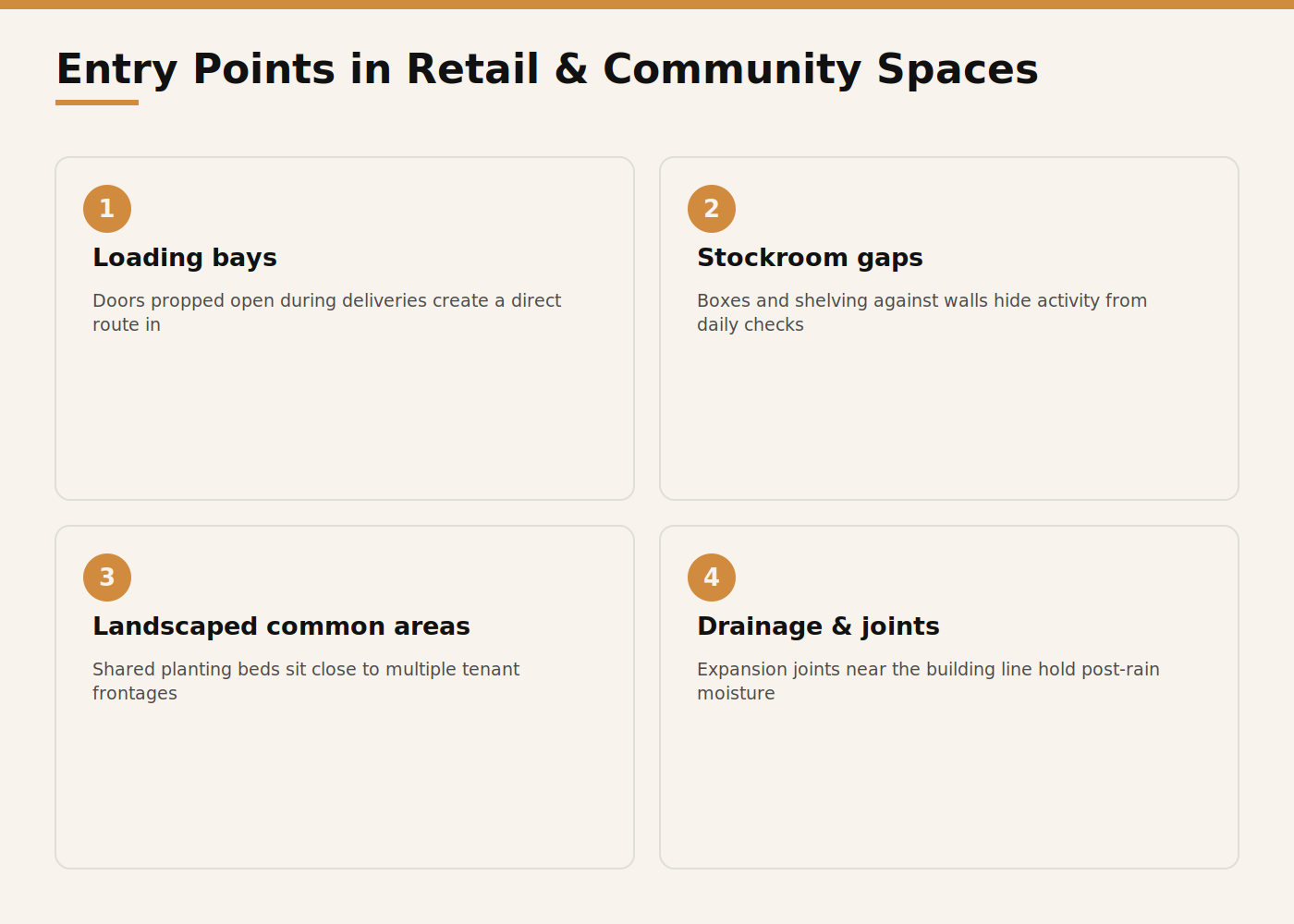
In almost every retail centipede and millipede case Santera attends after rain, the point of entry traces back to a loading bay, service corridor, or stockroom door left propped open during deliveries. These areas are usually at grade level, close to external landscaping or drainage, and see frequent door-opening during business hours, which is a very different exposure profile from a sealed residential entrance.
Stockrooms compound the problem because they are typically the least-inspected part of a retail unit. Boxes, pallets, and shelving against the wall create the same dark, undisturbed voids that centipedes favor, and a stockroom rarely gets the daily visual check that the shop floor does. By the time one is spotted near the till, it may have been established in the stockroom for days.
Community centers and retail developments in Dubai are often built with landscaped courtyards, planters, and green common areas that sit directly against multiple tenant frontages. This landscaping is valuable for footfall and appearance, but after rain it becomes a staging ground for centipede and millipede activity that no single tenant can manage alone.
Because the landscaping is shared, activity in one unit is rarely isolated. If irrigation beds or mulch areas along a community center walkway are holding excess moisture, every tenant fronting that walkway is at similar risk. This is why retail and community-center pest management works best as a coordinated effort between facilities management and individual tenants, rather than a one-off callout from a single shop.
Millipedes do not bite and centipedes rarely interact with people directly, so the practical health risk in a retail setting is low. The real cost is reputational. A pest sighting on a shop floor, captured on a phone and shared online, does more damage to a retail brand than the same sighting in a private home ever would. Community centers carry a similar risk at the property level, where a single visible incident affects perception of every tenant on site, not just the one where it happened.
This is why retail and community-center clients typically want a faster response and a more visible resolution than residential clients. Same-day service matters here in a way it may not for a garden sighting that can wait until the weekend.
An effective inspection of a Dubai retail unit or community center after a sighting looks beyond the point where the pest was seen. It should cover loading bays and service doors for gaps or damaged seals, stockroom perimeters and behind fixed shelving, drainage points and expansion joints near the building line, and the landscaping directly outside the affected frontage.
For community centers with shared common areas, the inspection should also map how many tenants border the same landscaping or drainage run, since treating one unit while ignoring the shared source rarely holds for long. This is where a complimentary inspection earns its value: it identifies the actual entry point rather than just the symptom on the shop floor.
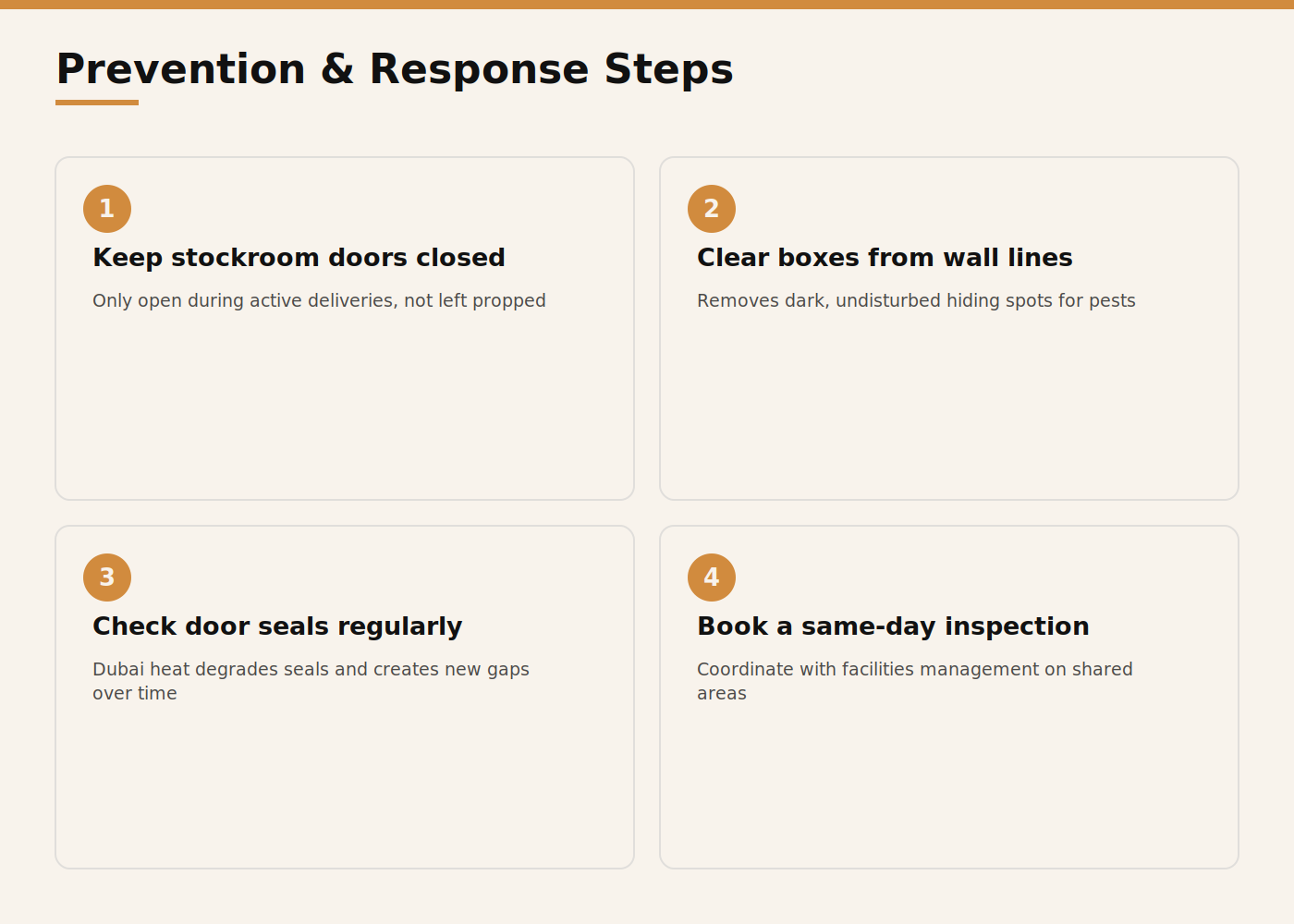
Retail staff can reduce risk between professional visits by keeping stockroom doors closed outside of active deliveries, clearing stored boxes away from wall lines, and checking door seals and threshold gaps on loading entrances periodically, since these degrade over time in Dubai's heat. Facilities managers responsible for community-center common areas should prioritize drainage maintenance around landscaped beds and keep mulch or heavy ground cover pulled back from building perimeters, particularly ahead of the rainy season. None of this replaces a professional treatment plan, but it reduces how often these pests find a viable route in.
Because retail strips and community centers share landscaping, drainage, and often structural voids, the most effective approach treats the property as a whole rather than one unit in isolation. Santera works with both individual retail tenants and facilities or community management teams to align treatment across affected frontages, so one tenant's stockroom is not re-exposed a week later by an untreated planting bed two doors down. Every treatment plan includes our 30-day warranty with follow-up support, covering continued activity of the same pest within the agreed scope, so a retail team is not left managing a repeat sighting alone.
You can find more detail on identification and biology on our centipedes and millipedes pest library page.
Rain drives moisture-seeking centipedes and millipedes out of soil, landscaping beds, and drainage areas toward the nearest dry shelter. Loading bays, stockroom entrances, and gaps under external doors give them a direct route into a retail unit, especially in units bordering landscaped common areas.
A single sighting rarely means an infestation, but on a customer-facing retail floor it carries a reputational cost that a home sighting does not. It is worth a same-day inspection to check entry points and stockroom conditions before it repeats during trading hours.
This typically splits between individual tenants, who are responsible for their own unit, and facilities or community management, who are responsible for shared landscaping, corridors, loading docks, and drainage. Coordinated treatment across both is more effective than a single tenant treating in isolation.
Millipedes do not bite and are not a health hazard, though they can release a defensive odor if crushed. Centipedes can deliver a mild pinch if handled, but this is uncommon in a retail setting. The bigger concerns are customer perception and repeated indoor sightings signalling a moisture or entry-point issue nearby.

Santera is Dubai Municipality certified, with 25+ years of team experience, 4.9 stars on Google Reviews, and over 10,000 successful treatments across the city. We offer 24/7 availability with same-day service across Dubai, so a shop-floor sighting or a community center complaint does not have to wait. Book your complimentary inspection via WhatsApp - same-day service available across Dubai.