Bees
Bee and Hive Removal for Dubai Warehouses and Industrial Yards: Managing Swarms Near Loading Bays and Stored Goods
Muhammad Saif Ullah
September 15, 2026


A forklift operator radios in that bees are swarming near loading bay 4. Within minutes, that single bay is off-limits, pallets scheduled for dispatch are stuck behind a hazard zone, and your warehouse safety officer is fielding questions nobody has a script for. Across Dubai's logistics corridors, from Al Quoz and Ras Al Khor to Jebel Ali and Dubai Investments Park, this scenario plays out more often than most facility managers expect, especially as temperatures climb and colonies search for stable, sheltered cavities away from direct sun.
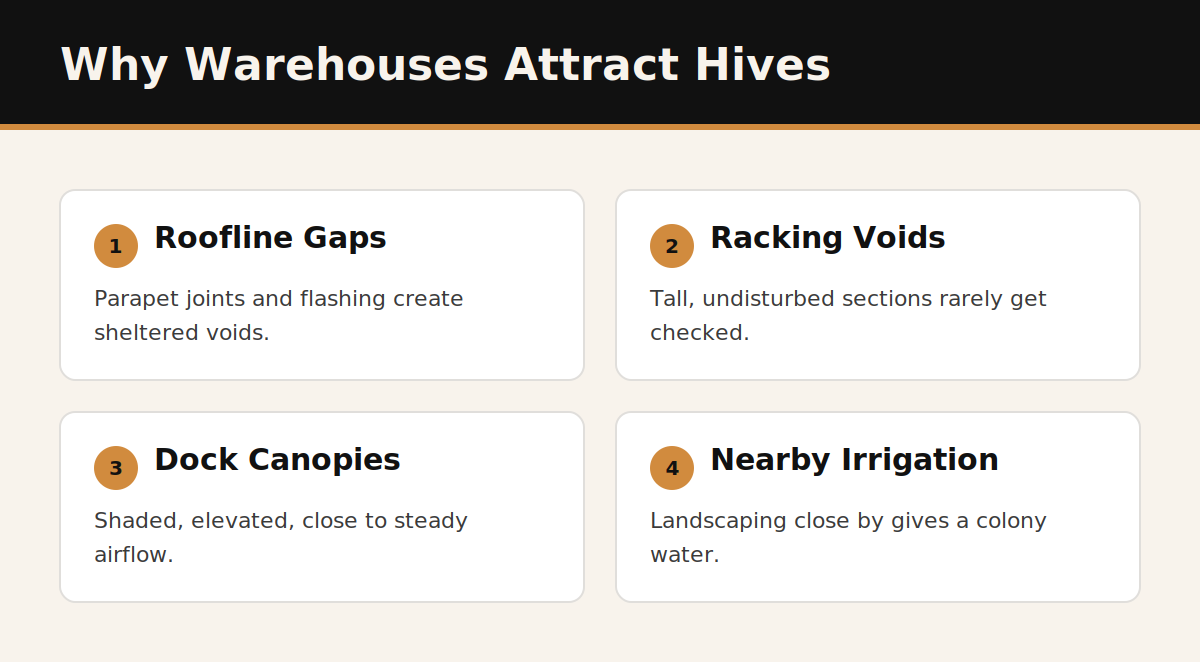
Warehouses and industrial yards are, unfortunately, close to ideal for bee colonies. Tall racking, exposed rooflines, external plant rooms, and gaps around loading dock structures all offer the dark, undisturbed voids that a colony needs to establish a hive. Add nearby landscaping or irrigation for water, and a single dock area can become an attractive site for a colony to settle in and grow for weeks before anyone notices the increase in traffic near the eaves.
Unlike a villa garden or a retail forecourt, an industrial site offers a colony scale: large, mostly undisturbed roof cavities, tall external walls with expansion gaps, and racking systems that go untouched for long stretches between stock rotations. In Dubai's climate, bees actively seek shaded, insulated voids once outdoor temperatures rise, and a warehouse roofline or a gap behind cladding provides exactly that. Facilities near green belts, irrigation canals, or landscaped business park frontages see this more frequently, since foraging bees are drawn to nearby moisture and blooming shrubs before they scout a nesting site.
Santera's technicians most commonly find hives in a handful of predictable locations across Dubai industrial sites: void spaces above suspended ceilings near loading docks, gaps in roofline flashing and parapet walls, disused racking sections at height that are rarely accessed, external electrical or plant enclosures, and cavities behind cladding on the yard-facing side of a building. Loading bay canopies are a particular hotspot because they are sheltered, elevated, and close to a steady stream of outdoor air, which bees use to regulate the hive.
The operational risk of a hive near a loading bay is different from a hive on a villa balcony. Forklift and pallet-truck operators working near an agitated colony face a genuine safety hazard, particularly for staff with known sting allergies. Dock doors may need to stay open for loading and unloading, which keeps a flight path active right where people and vehicles move. A defensive swarm reacting to vibration, engine noise, or a disturbed panel can halt operations at that bay entirely until the area is assessed and made safe.
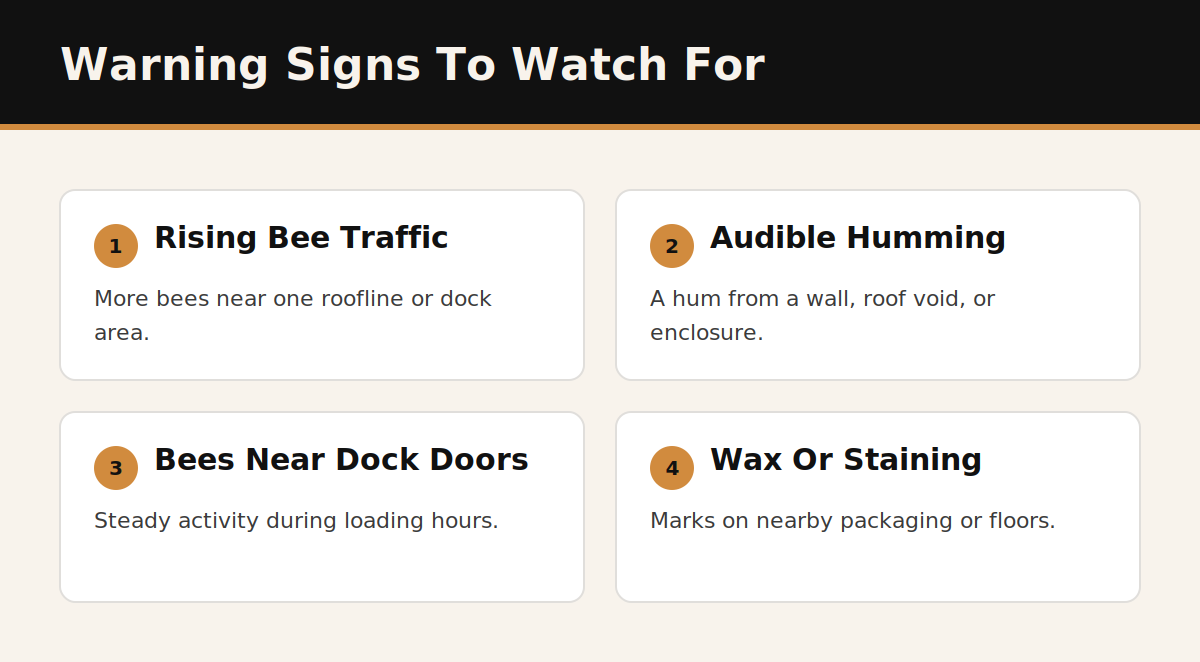
Facility managers understandably worry about what a hive removal does to inventory. A colony established near stored goods can, over time, affect packaging through wax, propolis staining, or moisture from the hive itself, particularly on porous cartons stored close to the structure. Santera's process is designed around your stock, not against it: technicians assess the hive's position relative to pallets and racking before any work begins, and use humane relocation techniques rather than aggressive removal that could disturb stacked goods or trigger a defensive response near sensitive inventory.
Santera's approach to bees in any Dubai setting, including industrial sites, is humane relocation of the colony rather than extermination. Bees play a role in the wider environment, and a warehouse operator does not need to choose between worker safety and responsible pest management. Technicians assess the colony, plan a relocation approach suited to the specific void or structure, and safely relocate the colony while including a 30-day warranty with follow-up support if activity continues in the same treated area within the agreed scope.
Any of these signs near an active operational zone warrants a proper assessment rather than a wait-and-see approach, since colonies tend to grow quickly once established in a sheltered industrial void.
A practical response starts with restricting access to the immediate area, not the whole facility. Warehouse safety officers should cordon off the specific bay, aisle, or dock door involved, brief staff to avoid the zone rather than attempt removal themselves, and document the location for the inspecting technician. Santera's technicians then carry out a complimentary inspection to confirm the hive's exact location and scale before recommending a relocation plan, so your team knows what to expect and roughly how much of the site will be affected.
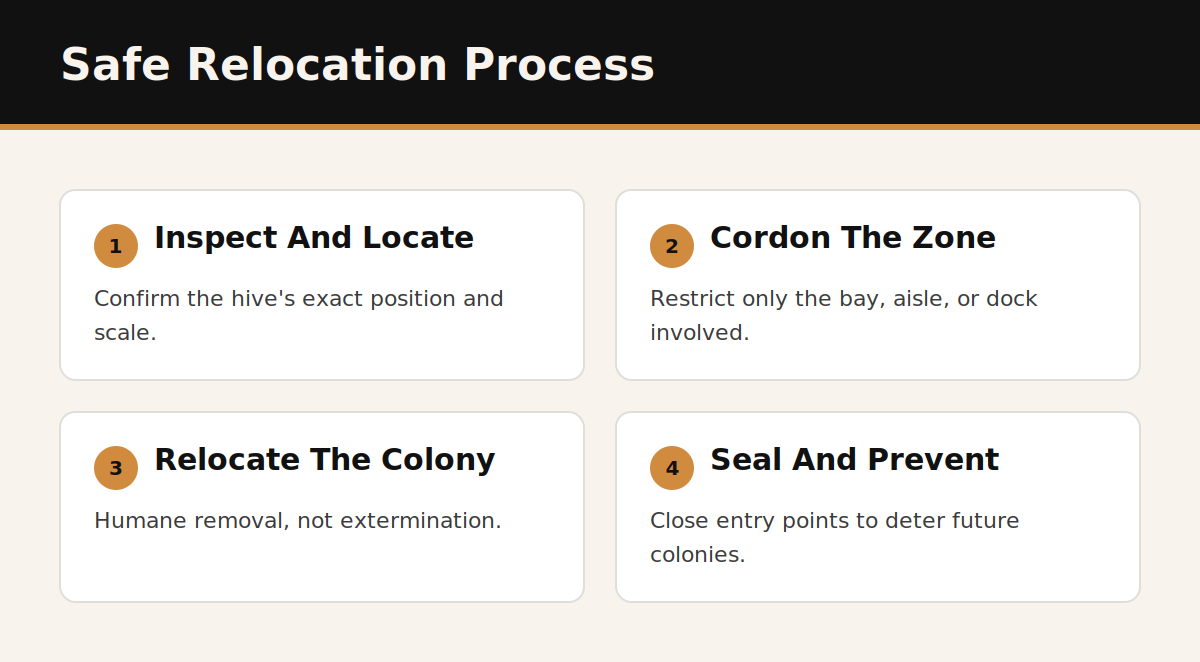
Because Dubai's industrial buildings often share similar construction, the same roofline gaps, parapet joints, and dock canopy voids that attracted one colony can attract another if they are not addressed. After a relocation, sealing identified entry points, maintaining landscaping and irrigation at a reasonable distance from loading areas, and scheduling periodic checks of high-level roof and cladding areas during warmer months all reduce the likelihood of a repeat hive on the same structure.
For background on bee behavior and hive biology relevant to Dubai properties, see Santera's Pest Library page on bees.
Warehouses and industrial yards in Dubai offer steady shelter in racking voids, rooflines, and external plant rooms, plus nearby irrigation or landscaping that gives a colony water. If a previous hive was removed but the structural gap or void was never sealed, the same cavity often attracts a new colony within a season.
In most cases, yes. Santera's technicians cordon off only the immediate zone around the hive, often a single bay, aisle, or loading dock, while the rest of the facility continues operating. Full closures are rare and are only recommended when a hive sits directly above a primary walkway or dock door with no safe detour.
Santera's approach is built around minimizing disruption to inventory. Technicians assess the hive location relative to stored goods before starting, use humane relocation methods rather than aggressive extraction, and coordinate timing with your warehouse team so pallets, packaging, or racking are not disturbed unnecessarily.
Santera offers 24/7 availability with same-day service across Dubai, which matters most when a swarm settles near an active loading bay and staff cannot safely continue operations. Contact us via WhatsApp and a technician will assess urgency and schedule accordingly.
No. Santera's standard approach for bees is humane relocation of the colony, not extermination or blanket spraying. Where any product is needed as part of the process, only Dubai Municipality-approved professional products are used, and never inside active storage or loading areas without a documented safety plan.
A hive near a loading bay does not have to mean a shutdown or a guessing game about safety. Santera is Dubai Municipality certified, rated 4.9 stars on Google, and has completed 10,000+ successful treatments across Dubai, including industrial sites where safety and stock protection matter as much as removing the colony. Book your complimentary inspection via WhatsApp and a technician can assess your loading bay, roofline, or yard the same day, with humane relocation and a 30-day warranty with follow-up support.