24/7 Pest Control in the UAE

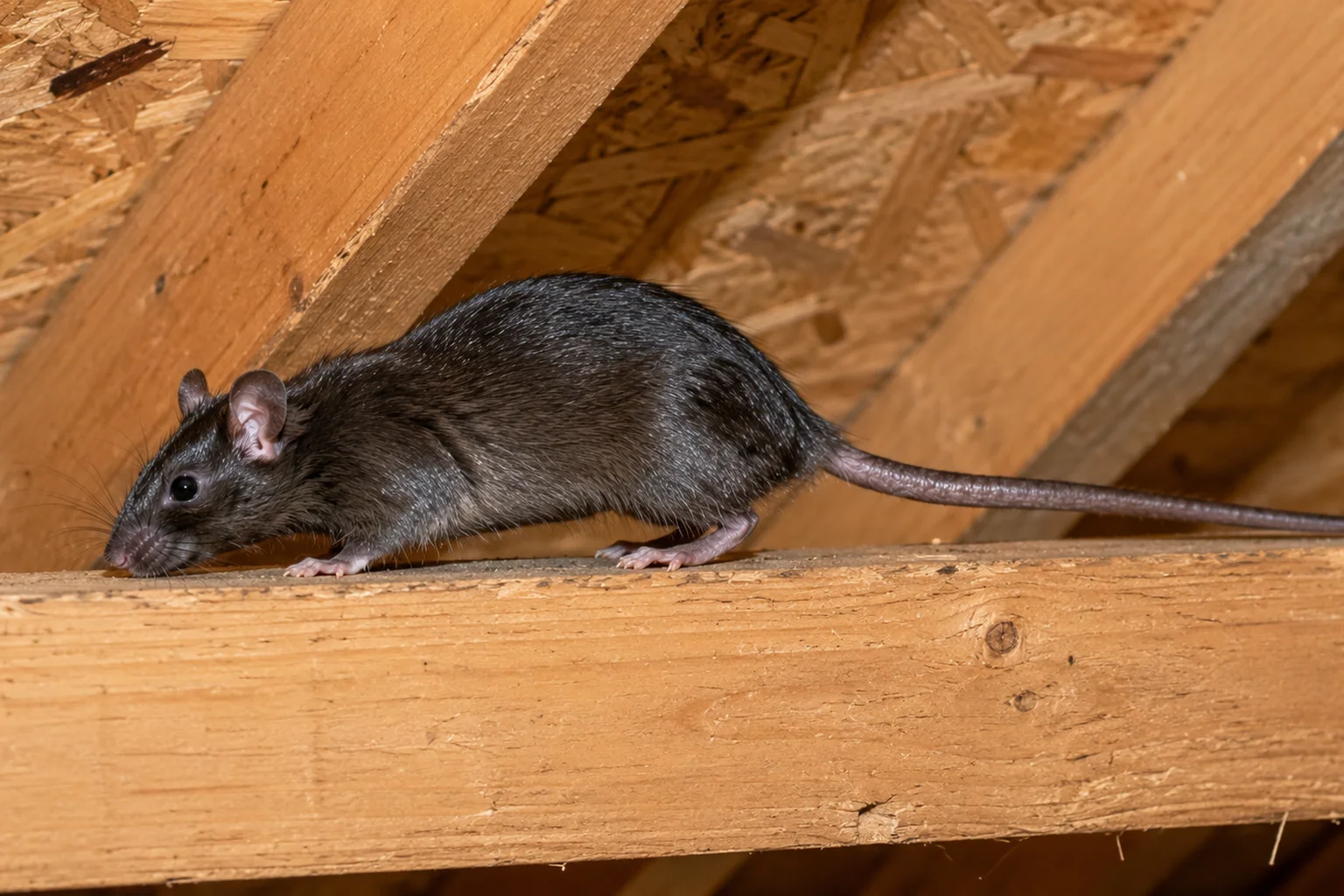
The Roof Rat (also called the black or ship rat) is an expert climber, and that changes everything about how it invades Dubai properties. Rather than burrowing at ground level, it enters from above — scaling exterior walls, cables, pipes, and trees — and nests in roof voids, false ceilings, attics, and upper floors. It's the rodent most often heard scratching in ceilings at night in villas, and it readily travels between units in high-rise buildings via service risers and cable runs. It gnaws wiring (a fire risk), contaminates stored food, and spreads disease. Because it nests high and out of sight, ground-level traps usually miss it.
Santera's Dubai Municipality-certified technicians target Roof Rats with inspection of roof voids, ceilings, and elevated runs, followed by trapping and secured baiting at height and along their aerial routes, plus proofing of the gaps, cable entries, and roofline access points they use. For property managers and food businesses, we provide documented programmes aligned with HACCP and Dubai Municipality standards.
Get to know the physical signs and behavioral patterns associated with this species. Knowledge of these specific traits helps in maintaining a secure and pest-free environment.
Santera provides Pest control and prevention across Dubai, with primary service coverage in:

Santera gets rid of Roof Rats in Dubai with a Dubai Municipality-certified process: our technicians inspect to find the nests and entry points and entry points, apply targeted treatment that eliminates the problem at its source, and put prevention measures in place so it doesn't come back. For restaurants, hotels, and food businesses, all work follows HACCP protocols and Dubai Municipality standards.
You can try, but DIY rarely solves a Roof Rat problem in Dubai for good. Shop-bought sprays and home remedies tend to deal with what you can see while missing the nests and the gaps that let them in, so the problem returns. Lasting control means targeting the source — which is where professional treatment makes the difference.
Because the source survives. A female Roof Rat produces 4–6 litters a year of around 5–8 young, maturing in roughly 3 months. With abundant food and warm conditions in Dubai, populations grow rapidly year-round, and their elevated nesting lets colonies establish in ceilings and roof voids before they're noticed. That's exactly why surface sprays and one-off DIY fail — they hit what's visible while the source keeps producing more, so lasting control has to target the source, not just the symptoms.
Watch for Roof Rats themselves and the signs they leave. Roof Rats are slender, agile rodents with a body length of 16–22cm and a tail longer than the body. Roof Rats are exceptional climbers and prefer to live above ground — in roof spaces, false ceilings, upper floors, trees, and along overhead cables and pipes. They are nocturnal, cautious, and follow elevated runs, leaving smear marks and droppings along beams and pipes. Catching it early, before numbers build, makes treatment far easier.
Yes — Roof Rats can bite and pose a real health risk, spreading disease through droppings and urine and gnawing through wiring (a fire hazard) as they nest in ceilings and roof voids.
Roof Rats are omnivorous but favour fruit, seeds, nuts, and plant material, earning the name 'fruit rat', while also eating grains and food waste. In Dubai they exploit fruiting trees, garden produce, pet food, and stored food in elevated storage. They contaminate far more than they consume and need access to water. Cut off these food, water, and shelter sources and you remove what draws them in — but an established population still needs targeted treatment to clear fully.