How Do I Get Rid of Pest in Dubai?

Pharaoh Ants are a serious problem for Dubai's hotels, restaurants, healthcare facilities, and apartment buildings. Barely 2mm long and pale yellow, they nest deep inside wall voids, behind tiling, in electrical fittings, and along warm pipe runs — almost impossible to locate by eye. They contaminate food and can carry harmful bacteria across kitchens and sensitive areas. The critical mistake is spraying them: repellent insecticides trigger 'budding', where the colony deliberately splinters into multiple new colonies, turning one problem into many across an entire building.

Santera's Dubai Municipality-certified technicians never spray Pharaoh Ants. We deploy a strict bait-only protocol using slow-acting baits that workers carry back to feed the queens and brood, collapsing the entire interconnected colony network. For multi-unit buildings and F&B operators, we treat as a coordinated, building-wide programme — the only approach that works against this species — fully aligned with HACCP and Dubai Municipality hygiene standards.

Book Your Free Inspection

Species Insights & Biology

Get to know the physical signs and behavioral patterns associated with this species. Knowledge of these specific traits helps in maintaining a secure and pest-free environment.

Appearance

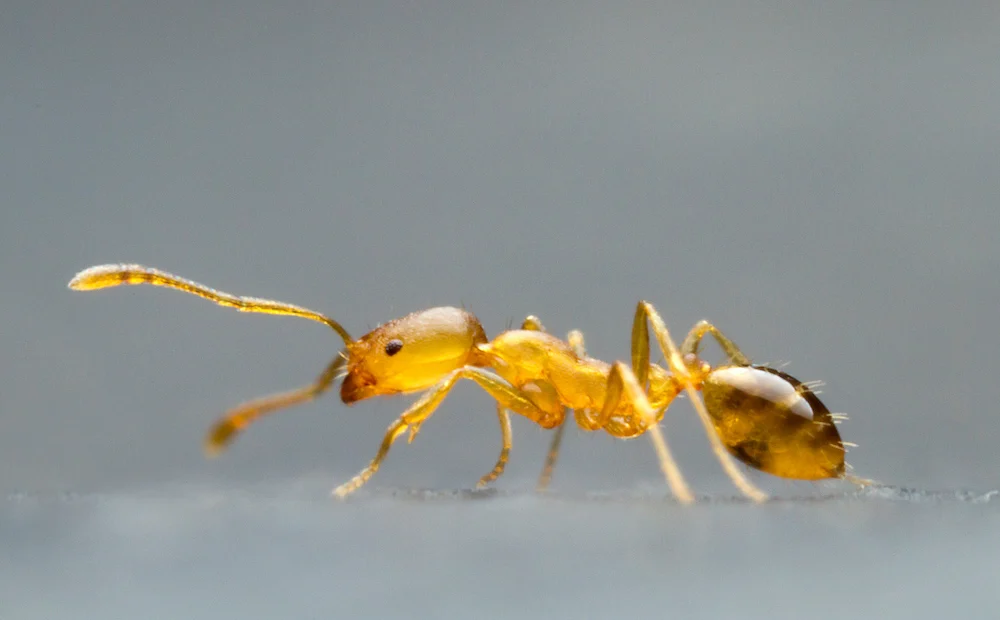
Pharaoh Ants are very small, measuring just 1.5–2mm. They are pale yellow to light brown, often with a slightly darker abdomen, and the body is faintly translucent. They have a two-segmented waist and 12-segmented antennae ending in a distinct three-segmented club. Their tiny size and pale colour make them easy to overlook until trails appear near food or water.

Diet

Pharaoh Ants prefer protein- and fat-rich foods such as meats, grease, and dead insects, but also feed on sugars and sweets. In Dubai kitchens, hospitals, and pantries they exploit the smallest food traces, and are notably attracted to moisture, often foraging near sinks, drains, and water sources. Their wide diet supports very large, fast-growing colonies.

Behavior

Pharaoh Ants nest in warm, humid, hidden voids — inside walls, behind skirting, in electrical sockets, and along pipe and cable runs. They forage in trails across counters, floors, and equipment. Their defining behaviour is budding: when stressed by sprays or threats, the colony splits and reproductive groups relocate to form new nests, rapidly spreading the infestation through a building. This makes them exceptionally persistent.

Reproduction

Colonies are highly polygynous, containing many active queens. Reproduction is continuous indoors, with no need for nuptial flights — new colonies form by budding, where queens and workers break away to establish satellite nests. A single colony can contain thousands of workers and hundreds of queens, and the budding response is exactly why fragmented DIY treatment makes infestations worse.

Prevention Tips

Eliminate moisture sources and fix leaks, as Pharaoh Ants are strongly drawn to water. Store all food in sealed, airtight containers and clean up grease and food residue immediately, especially in kitchens. Never spray these ants — it splits the colony; use bait or call a professional. Seal gaps around pipes, sockets, and skirting. For hotels, restaurants, and apartment buildings, a scheduled Santera monitoring programme is the most reliable defence.

Where We Treat Pest in Dubai

Santera provides Pest control and prevention across Dubai, with primary service coverage in:

place
Dubai Creek Harbour
place
City Walk
place
Bluewaters
place
Palm Jumeirah
place
Dubai Festival City
place
Jumeirah Islands
place
Jumeirah Park
place
Meydan
place
The Valley
place
DAMAC Lagoons
place
DAMAC Hills 2
place
Sobha Hartland
place
Sustainable City
place
International City
place
Dubai Sports City
place
Dubai Silicon Oasis
place
The Greens
place
Discovery Gardens
place
Al Furjan
place
Barsha Heights
place
Ibn Battuta
place
Mall of the Emirates
place
Dubai Mall
place
DAFZA
place
Jebel Ali
place
Al Quoz
place
Dubai Industrial City
place
Dubai Investment Park
place
JAFZA
place
Sheikh Zayed Road
place
Media City
place
Internet City
place
Jumeirah Beach
place
La Mer
place
DIFC
place
City Walk
place
Bluewaters
place
Downtown
place
Palm Jumeirah
Pharaoh Ants

Common Questions & Expert Answers

Book Your Free Inspection
How does Santera get rid of Pharaoh Antses in Dubai?

Santera gets rid of Pharaoh Antses in Dubai with a Dubai Municipality-certified process: our technicians inspect to find the colony and entry points, apply targeted treatment that eliminates the problem at its source, and put prevention measures in place so it doesn't come back. For restaurants, hotels, and food businesses, all work follows HACCP protocols and Dubai Municipality standards.

Can I get rid of Pharaoh Antses myself, or do I need professional pest control?

You can try, but DIY rarely solves a Pharaoh Ants problem in Dubai for good. Shop-bought sprays and home remedies tend to deal with what you can see while missing the colony hidden underground or in wall voids, so the problem returns. Lasting control means targeting the source — which is where professional treatment makes the difference.

Why do Pharaoh Antses keep coming back after I treat them?

Because the source survives. Colonies are highly polygynous, containing many active queens. Reproduction is continuous indoors, with no need for nuptial flights — new colonies form by budding, where queens and workers break away to establish satellite nests. That's exactly why surface sprays and one-off DIY fail — they hit what's visible while the source keeps producing more, so lasting control has to target the source, not just the symptoms.

How do I know if I have a Pharaoh Ants problem in Dubai?

Watch for Pharaoh Antses themselves and the signs they leave. Pharaoh Ants are very small, measuring just 1.5–2mm. Pharaoh Ants nest in warm, humid, hidden voids — inside walls, behind skirting, in electrical sockets, and along pipe and cable runs. They forage in trails across counters, floors, and equipment. Catching it early, before numbers build, makes treatment far easier.

Are Pharaoh Antses dangerous?

Pharaoh Ants don't sting, but they're a serious public-health risk in food service and healthcare, able to carry and spread pathogens including salmonella and streptococcus across food and surfaces.

What attracts Pharaoh Antses to homes and businesses in Dubai?

Pharaoh Ants prefer protein- and fat-rich foods such as meats, grease, and dead insects, but also feed on sugars and sweets. In Dubai kitchens, hospitals, and pantries they exploit the smallest food traces, and are notably attracted to moisture, often foraging near sinks, drains, and water sources. Their wide diet supports very large, fast-growing colonies. Cut off these food, water, and shelter sources and you remove what draws them in — but an established population still needs targeted treatment to clear fully.

Experience Guaranteed Results and Satisfied Pest Treatment Services

20+

Years Experience

All

Across UAE

10k+

Treatments

Select a Service

What pest problem can we help you with?

Property Details

Tell us about your property

Choose Date & Time

When would you like us to visit?

Contact Information

How can we reach you?

Expert Help is on the Way!

We’ve received your request. Santera is ready to protect your home/business—talk to you soon!
Oops! Something went wrong while submitting the form.