24/7 Pest Control in the UAE

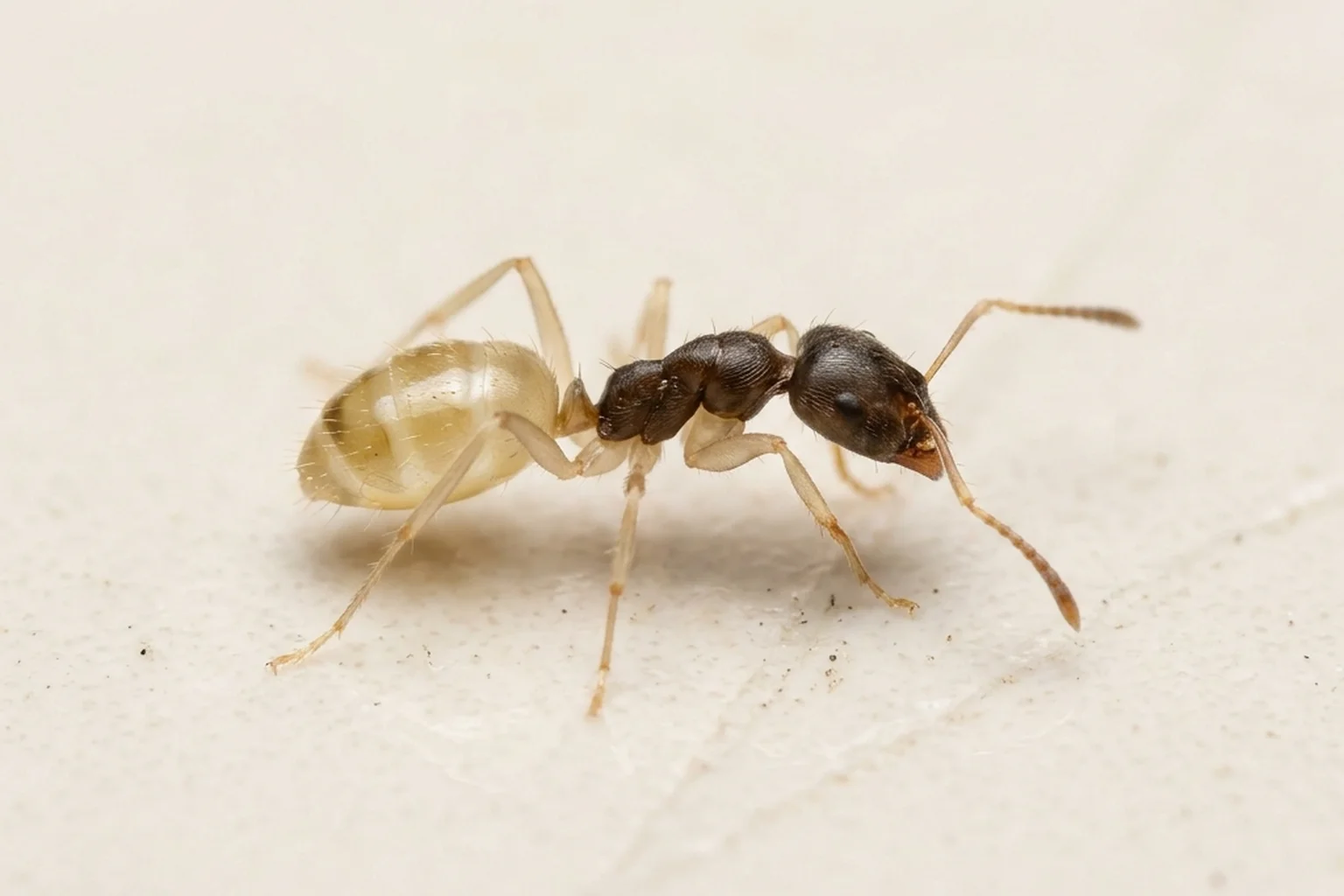
Ghost Ants are a frequent indoor pest in Dubai's apartments, villas, and food businesses, named for their pale, near-translucent bodies that make them very hard to spot. They love warmth and humidity, nesting in wall voids, behind skirting, inside potted plants, and near kitchens and bathrooms. A single colony often occupies multiple nesting sites at once. Like other budding ants, they respond to repellent sprays by splitting the colony into new nests — so DIY spraying typically multiplies the problem instead of solving it.
Santera's Dubai Municipality-certified technicians treat Ghost Ants with a precise, bait-led approach. We follow their faint trails to locate the multiple nests, then use slow-acting baits that workers carry back to the queens and brood, collapsing the whole colony network. We focus on kitchens, bathrooms, and humid harbourage where they thrive. For apartment buildings and F&B operators, we coordinate treatment across affected areas, fully aligned with HACCP and Dubai Municipality hygiene standards.
Get to know the physical signs and behavioral patterns associated with this species. Knowledge of these specific traits helps in maintaining a secure and pest-free environment.
Santera provides Pest control and prevention across Dubai, with primary service coverage in:

Santera gets rid of Ghost Antses in Dubai with a Dubai Municipality-certified process: our technicians inspect to find the colony and entry points, apply targeted treatment that eliminates the problem at its source, and put prevention measures in place so it doesn't come back. For restaurants, hotels, and food businesses, all work follows HACCP protocols and Dubai Municipality standards.
You can try, but DIY rarely solves a Ghost Ants problem in Dubai for good. Shop-bought sprays and home remedies tend to deal with what you can see while missing the colony hidden underground or in wall voids, so the problem returns. Lasting control means targeting the source — which is where professional treatment makes the difference.
Because the source survives. Colonies are polygynous with multiple queens and reproduce largely by budding, where queens and workers break away to start new nests nearby. This continuous, flight-independent reproduction indoors allows colonies to expand steadily and recover quickly from partial treatment, making professional, colony-wide control important. That's exactly why surface sprays and one-off DIY fail — they hit what's visible while the source keeps producing more, so lasting control has to target the source, not just the symptoms.
Watch for Ghost Antses themselves and the signs they leave. Ghost Ants are very small, measuring just 1.3–2mm. Ghost Ants are primarily indoor nesters in warm, humid locations — wall voids, behind skirting, inside potted soil, and near plumbing. A single colony commonly spreads across multiple nesting sites. Catching it early, before numbers build, makes treatment far easier.
Ghost Ants don't sting, but they contaminate food and surfaces and, like Pharaoh Ants, can split into multiple colonies when sprayed incorrectly, spreading the infestation.
Ghost Ants strongly prefer sweets and honeydew but also feed on proteins and grease. Indoors they are drawn to sugary spills, syrups, and food residue, and are commonly found foraging in kitchens and around bins. Their sweet tooth and small size let them exploit tiny food traces, sustaining large indoor colonies in Dubai homes and food premises. Cut off these food, water, and shelter sources and you remove what draws them in — but an established population still needs targeted treatment to clear fully.