24/7 Pest Control in the UAE

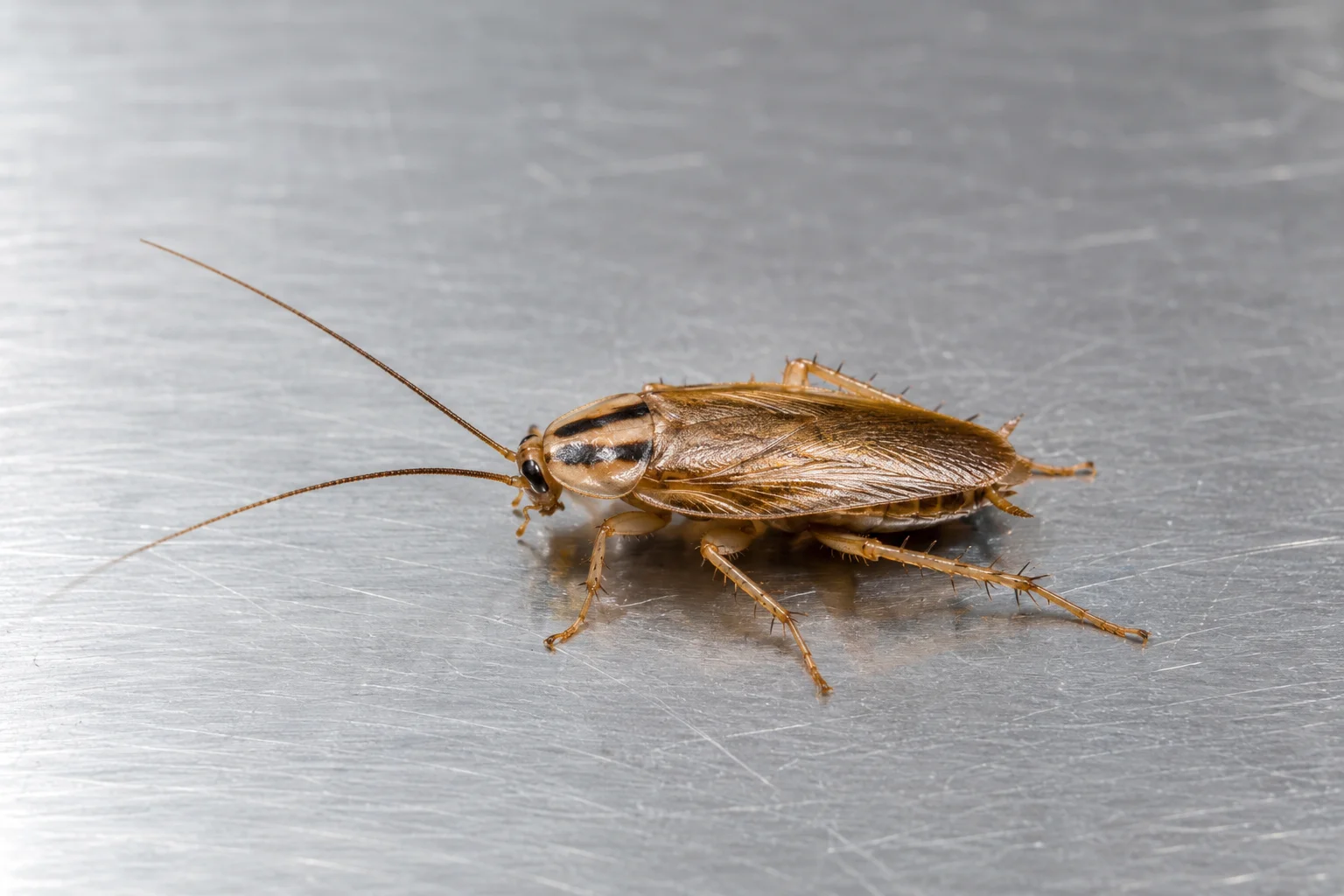
The German Cockroach is the species that keeps Dubai restaurant owners and facility managers awake at night. It thrives in exactly the conditions Dubai kitchens provide: warmth, humidity, and constant access to food and water. It hides in the tightest gaps — behind fridges, inside motor housings, under sinks, in cracks around equipment — and breeds faster than any other roach. Spotting one during the day means the harbourage points are already overcrowded. Retail sprays scatter them deeper into wall voids and equipment, and many populations in the region are now resistant to off-the-shelf insecticides, so DIY almost always fails.
Santera's Dubai Municipality-certified technicians treat German Cockroaches with a targeted gel-bait and growth-regulator programme that the roaches carry back to their harbourage, collapsing the population at source rather than scattering it. We inspect every void, hinge, and motor housing, treat precisely, and put monitoring in place to confirm elimination. For restaurants, cafes, hotels, and commercial kitchens, all work is coordinated with HACCP protocols and Dubai Municipality hygiene standards — protecting both your guests and your licence.
Get to know the physical signs and behavioral patterns associated with this species. Knowledge of these specific traits helps in maintaining a secure and pest-free environment.
Santera provides Pest control and prevention across Dubai, with primary service coverage in:

Santera gets rid of German Cockroaches in Dubai with a Dubai Municipality-certified process: our technicians inspect to find the hidden harbourage and entry points, apply targeted treatment that eliminates the problem at its source, and put prevention measures in place so it doesn't come back. For restaurants, hotels, and food businesses, all work follows HACCP protocols and Dubai Municipality standards.
You can try, but DIY rarely solves a German Cockroach problem in Dubai for good. Shop-bought sprays and home remedies tend to deal with what you can see while missing the harbourage and eggs hidden behind equipment and in voids, so the problem returns. Lasting control means targeting the source — which is where professional treatment makes the difference.
Because the source survives. German Cockroaches are the most prolific breeders of any pest roach. A single female produces an egg case (ootheca) holding 30–40 eggs and carries it until just before hatching, giving very high survival rates. That's exactly why surface sprays and one-off DIY fail — they hit what's visible while the source keeps producing more, so lasting control has to target the source, not just the symptoms.
Watch for German Cockroaches themselves and the signs they leave. German Cockroaches are small, measuring 13–16mm, light brown to tan in colour, with two distinctive dark parallel stripes running lengthwise behind the head (on the pronotum). German Cockroaches are nocturnal and prefer warm, humid, confined spaces close to food and water — behind and beneath kitchen equipment, inside cabinetry, around plumbing, and in electrical housings. They are highly thigmotactic, meaning they wedge into tight cracks for security. Catching it early, before numbers build, makes treatment far easier.
German Cockroaches don't bite, but they're a serious health risk: they contaminate food and surfaces with bacteria and are a leading trigger for asthma and allergies, especially in children.
German Cockroaches are omnivorous scavengers that feed on virtually anything — food crumbs, grease, starches, sugars, and even non-food materials like soap, glue, and toothpaste. In Dubai kitchens they concentrate around food prep areas, grease traps, bins, and appliance motors where warmth and food residue combine. Their broad diet allows colonies to survive on the smallest traces. Cut off these food, water, and shelter sources and you remove what draws them in — but an established population still needs targeted treatment to clear fully.