How Do I Get Rid of Pest in Dubai?

In Dubai's irrigated villa gardens — from Arabian Ranches to Al Barari to Emirates Hills — the Big-headed Ant builds year-round. Its supercolonies contain hundreds of queens spread across an underground network that can extend across an entire garden in a single season. The damage isn't only on the surface: these ants tunnel beneath paving slabs and walkways, eroding the soil until stones crack and sink. They also farm aphids and scale insects on ornamental plants, accelerating landscaping damage. Surface sprays kill the foragers you see; the queens survive and the colony rebuilds within days.

Santera's Dubai Municipality-certified technicians begin every treatment by mapping active nests and the underground network across your property. We apply slow-acting granular bait that workers carry directly to the queens, triggering complete colony collapse from within, then apply a residual barrier around your foundation, perimeter, and pool deck to prevent re-establishment. For F&B operators, hotels, and commercial properties, all treatments follow HACCP and Dubai Municipality standards.

Book Your Free Inspection

Species Insights & Biology

Get to know the physical signs and behavioral patterns associated with this species. Knowledge of these specific traits helps in maintaining a secure and pest-free environment.

Appearance

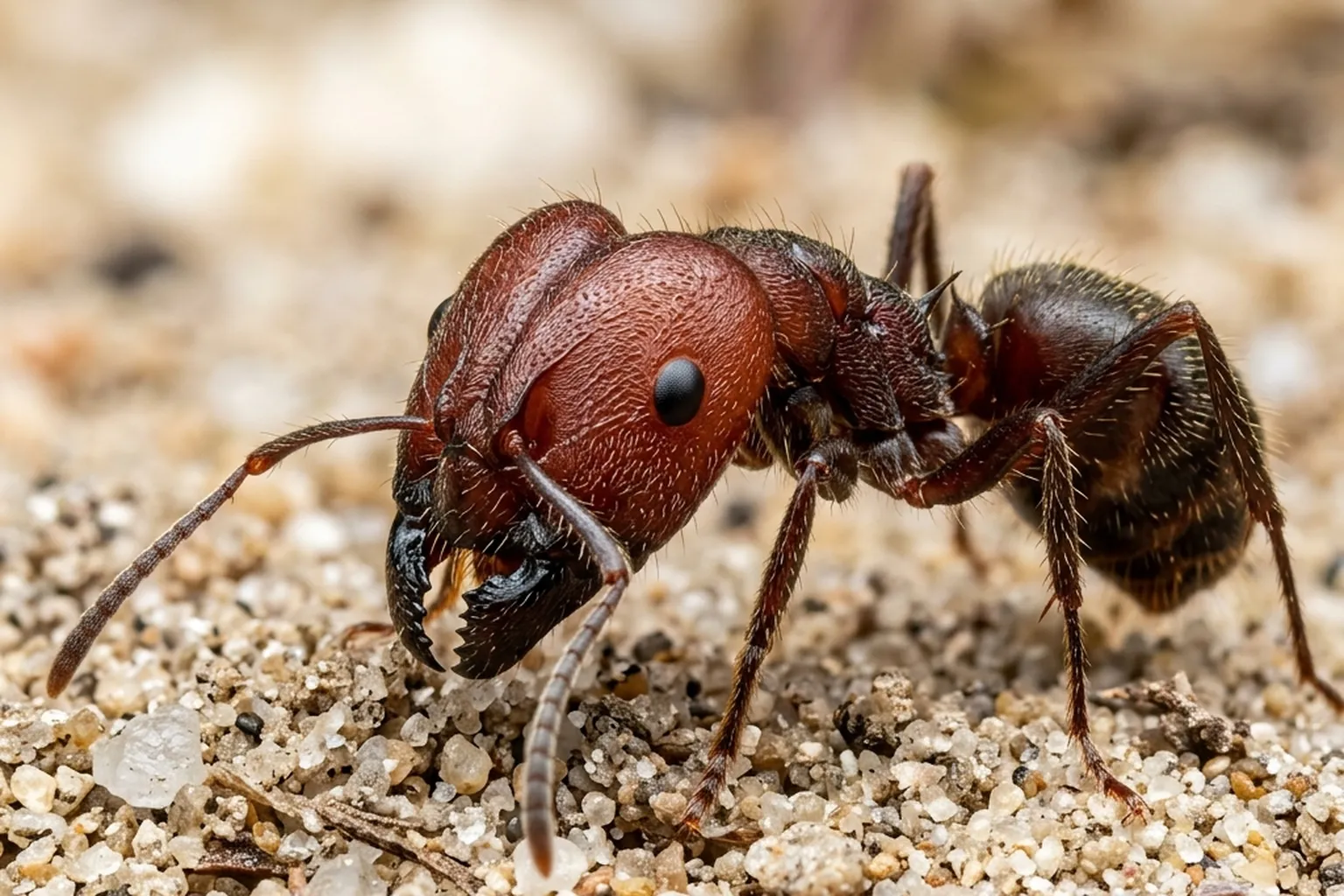
Big-headed Ant colonies contain two distinct worker types. Minor workers measure about 2mm and resemble typical small brown ants. Major workers (soldiers) measure 3.5–4mm and are distinguished by a disproportionately large, heart-shaped head with powerful mandibles. Both castes are glossy, ranging from yellowish-brown to dark reddish-brown. The stark difference in head size between workers on the same trail is the clearest identification marker. They do not sting.

Diet

Big-headed Ants are highly omnivorous. Minor workers forage for seeds, dead insects, proteins, and honeydew from aphids and scale insects, which they protect and farm on ornamental plants in villa gardens. They are equally drawn to protein-rich food debris on outdoor restaurant terraces and poolside dining areas, and to grease and sweet residues around outdoor kitchens.

Behavior

Ground-nesting and territorial, Big-headed Ants establish shallow nests in loose soil, beneath turf, under paving, and along tree root lines. Their tunnelling beneath concrete is a structural concern — pavers sink and joints crack over time. Minor workers form dense, consistent foraging trails along walls, irrigation pipes, and garden borders. Activity peaks in warmer months and in irrigated lawns where soil moisture is high.

Reproduction

Colonies are highly polygynous, containing hundreds of queens. They rarely swarm; instead they reproduce by budding, where workers and a fertile queen split off to form nearby satellite nests. These satellites link together into vast cooperative supercolonies, which is what makes the species so hard to control. A single untreated garden can host multiple interconnected colonies within one season.

Prevention Tips

Inspect garden turf edges and paving joints weekly for fine sandy mounds or disturbed soil — early signs of tunnelling. Keep a dry gravel border between planted beds and the villa foundation to disrupt foraging. Trim shrubs and trees back from exterior walls to remove bridging routes. Treat aphid and scale infestations promptly to cut off their honeydew food source. Book a quarterly Santera perimeter inspection to stop a new colony before it becomes a supercolony.

Where We Treat Pest in Dubai

Santera provides Pest control and prevention across Dubai, with primary service coverage in:

place
Dubai Creek Harbour
place
City Walk
place
Bluewaters
place
Palm Jumeirah
place
Dubai Festival City
place
Jumeirah Islands
place
Jumeirah Park
place
Meydan
place
The Valley
place
DAMAC Lagoons
place
DAMAC Hills 2
place
Sobha Hartland
place
Sustainable City
place
International City
place
Dubai Sports City
place
Dubai Silicon Oasis
place
The Greens
place
Discovery Gardens
place
Al Furjan
place
Barsha Heights
place
Ibn Battuta
place
Mall of the Emirates
place
Dubai Mall
place
DAFZA
place
Jebel Ali
place
Al Quoz
place
Dubai Industrial City
place
Dubai Investment Park
place
JAFZA
place
Sheikh Zayed Road
place
Media City
place
Internet City
place
Jumeirah Beach
place
La Mer
place
DIFC
place
City Walk
place
Bluewaters
place
Downtown
place
Palm Jumeirah
Big-headed Ants

Common Questions & Expert Answers

Book Your Free Inspection
How does Santera get rid of Big-headed Antses in Dubai?

Santera gets rid of Big-headed Antses in Dubai with a Dubai Municipality-certified process: our technicians inspect to find the colony and entry points, apply targeted treatment that eliminates the problem at its source, and put prevention measures in place so it doesn't come back. For restaurants, hotels, and food businesses, all work follows HACCP protocols and Dubai Municipality standards.

Can I get rid of Big-headed Antses myself, or do I need professional pest control?

You can try, but DIY rarely solves a Big-headed Ants problem in Dubai for good. Shop-bought sprays and home remedies tend to deal with what you can see while missing the colony hidden underground or in wall voids, so the problem returns. Lasting control means targeting the source — which is where professional treatment makes the difference.

Why do Big-headed Antses keep coming back after I treat them?

Because the source survives. Colonies are highly polygynous, containing hundreds of queens. They rarely swarm; instead they reproduce by budding, where workers and a fertile queen split off to form nearby satellite nests. That's exactly why surface sprays and one-off DIY fail — they hit what's visible while the source keeps producing more, so lasting control has to target the source, not just the symptoms.

How do I know if I have a Big-headed Ants problem in Dubai?

Watch for Big-headed Antses themselves and the signs they leave. Big-headed Ant colonies contain two distinct worker types. Ground-nesting and territorial, Big-headed Ants establish shallow nests in loose soil, beneath turf, under paving, and along tree root lines. Their tunnelling beneath concrete is a structural concern — pavers sink and joints crack over time. Catching it early, before numbers build, makes treatment far easier.

Are Big-headed Antses dangerous?

Big-headed Ants don't sting or pose a health threat, but they invade kitchens and gardens in huge numbers and can displace other species, making them a persistent nuisance.

What attracts Big-headed Antses to homes and businesses in Dubai?

Big-headed Ants are highly omnivorous. Minor workers forage for seeds, dead insects, proteins, and honeydew from aphids and scale insects, which they protect and farm on ornamental plants in villa gardens. They are equally drawn to protein-rich food debris on outdoor restaurant terraces and poolside dining areas, and to grease and sweet residues around outdoor kitchens. Cut off these food, water, and shelter sources and you remove what draws them in — but an established population still needs targeted treatment to clear fully.

Experience Guaranteed Results and Satisfied Pest Treatment Services

20+

Years Experience

All

Across UAE

10k+

Treatments

Select a Service

What pest problem can we help you with?

Property Details

Tell us about your property

Choose Date & Time

When would you like us to visit?

Contact Information

How can we reach you?

Expert Help is on the Way!

We’ve received your request. Santera is ready to protect your home/business—talk to you soon!
Oops! Something went wrong while submitting the form.